Feeds:
Posts
Comments

imgres

All of us have moments of fear. It is natural. It is human. I believe that one of the measures of our humanity is how we manage our fear. How far do we let it drive us? How much do we allow it to determine our life decisions? How does it affect our attitudes towards others? Fear can be a good thing. It can push us to actions that result in safety. Fear for loved ones can push us to acts of loving sacrifice. But the darkest side of fear pushes us to hatred, to denigration, even to acts of oppression. Excess fear creates darkness.

A couple of days ago I posted a piece in which I declared a blackout on writing or discussing a certain politician. Here is that link: https://thejewishobserver.com/2015/12/08/lets-shut-this-down-now/ This blog is not about him. It is about some of the reaction to the posting, in particular by those who support his policies regarding Muslims, immigration, and the Syrian refugees. This is about the fear they express and how it is driving a conversation that has turned very ugly. And yes, it is also about those who are against the policy suggestions aimed at Muslims, those who wish to welcome refugees, but use insulting, denigrating language to dismiss the fears of the anti-immigrant/anti-refugee crowd. We need to speak to each other reasonably, without name calling, without accusations of being unpatriotic, or stupid, or racist. We might believe any of those things in our hearts. Maybe we are right. Maybe we are wrong. But injecting pejoratives into the conversation is counter productive. So what I will speak about is fear and what it can force us to do.

Fear forces us to make generalizations; to make value judgments on people because of ethnicity, race or religion. As a result of African American attempts to get civil and political equality, white fear led to laws of segregation, attempts to keep blacks from voting, and perpetrated mythologies of black intellectual inferiority. On an even more obscene level, it spread myths about black desires – such as wanting to rape white women. So African Americans were categorized as non intellectual, but great athletes (and entertainers) who needed to be kept at a distance from white mainstream society. The suffering of blacks to just be able to order a soda at the same counter as whites is a sad commentary of American society.

Fear of Jews (most obviously in Germany/Europe but also to a certain extant in the US as well) cast Jews as money grubbers who wished to control society/government through their wealth. Aspersions such as the blood libel (Jews kill gentile children and use their blood to bake Passover matzah) have had legs for centuries. Father Coughlan was quite public in the 1930’s with his outright hatred for Jews in this country. Many shared his feelings. As a result, there was little support for admitting Jewish refugees from German or Europe leading up to World War II. A sad example is the story of the SS St. Louis, a boat filled with Jewish refugees who were refused safe harbor in 1939 in either Cuba or the United States. The boat returned to Europe and most of the Jews on board died in the Holocaust.

Fear in each of these historical examples also shapes the responses of the victims. Many, led by brave and insightful leaders, fight for equal rights. That is how history and attitudes can change. We need visionary leaders who point a way past fear and the resulting bigotry. But, and this is important, another reaction within the oppressed groups, is submission – the sad acceptance of their fate and position. In Germany during the 1930’s, Jews were so in shock that the country in which they had assimilated and succeeded was rejecting them. Fear often kept them from protesting. In our country, African American communities have been filled with tensions regarding how much to protest versus how much to just go along in the name of safety. Talk to African Americans today, and many fear the police. Fear can drive us in multiple directions.

Now we are dealing with a new, different fear: Muslims. It is different because there is a tangible reason for our fear. Muslims have perpetrated devastating terrorist attacks in this country and Europe. ISIS is an expression of a twisted variety of Islam that perpetrates a range of horrors. In a world in which images are transmitted instantaneously, the fear generated by these events goes viral within minutes of an event. Let me be blunt with my liberal friends. By refusing to acknowledge these realities, by pretending there is no connection to Islam, you are creating a fear in conservatives that you are too dense to appreciate the threat. Let me be equally blunt with my conservative friends. By refusing to see there are radical elements that have and still do come into play in ALL religions, not just Islam, you are allowing your fear to descend into bigotry. Everyone needs to see, for example, that the shootings at the Planned Parenthood in Colorado Springs, and the shootings in San Bernadino are both terrorist acts. Both have connections to religion. Conservatives will say the Colorado Springs shooter was mentally ill. I would argue that an American born Muslim with a good job who embraces ISIS and kills 14 people is also mentally ill.

Fear of Muslims drives us to consider stopping all Muslims from entering our country. Fear of Muslims drives us to see certain politicians as “truth tellers” instead of ignorant egotists. Fear of Muslims drives us to applaud suggestions like shutting down mosques, or creating a database of Muslims in America. Fear of Muslims pushes us to consider steps that compromise our basic liberties in the name of security. Fear of Muslims prevents us from being the America most of us would like to be.

Fear affects the American Muslim community as well. Imam Nidal Alsayyed of Beaumont, Texas did an interview with his local TV station in which he said he understood why some politicians want the limits on immigration. He did not criticize proposals aimed specifically at Muslims and he said Muslims need to demonstrate they are with their fellow Americans. I would say that American Muslims demonstrate their commitment to the United States all of the time. Muslims serve in our armed forces, contribute to all aspects of American life. The previous U. S. attorney for our region told me of the cooperation and the tips she received from the Muslim community while investigating potential terrorist threats. Surely Imam Alsayyed knows these things. Why would he feel the need passively endorse anti-Muslim policies put forth by politicians like Donald Trump? Well, Beaumont is a small town near the Louisiana border. It is in one of the least tolerant states, in the least tolerant areas of our country. I would speculate that he is experiencing the same fear that all minorities under suspicion experience. I am saddened if he feels intimidated to endorse actions that would be detrimental and insulting to his community. As I said, we are too motivated by fear and not enough by principle, or by morality.

It is significant we are in the middle of Chanukah, the festival that celebrates the victory of the Maccabees over the religious oppression of the Greek-Assyrians. It is not significant because of the military victory, which is certainly an expression of bravery and belief in the principle of religious freedom. Rather, the choice of the rabbis of the Talmud to emphasize the miracle of the oil over the military victory is significant. They chose to highlight the creation and furtherance of light over violence. What is that light? Psalm 97 states, Or zarua latzaddik ul’yishrei lev simchah. “Light is sown for the righteous, and gladness for the upright of heart.” Perhaps the light is the light produced by righteousness, a light that triumphs over the darkness of fear, and that lifts the feeling of gladness in our hearts. May we be inspired to spread that light, giving us the strength to turn away from the darkest side of fear.


la-ed-trump-boycott-20150709-002

I am not given to rants, especially about political candidates. But, as Popeye once said, “That’s all I can stands, and I can’t stands no more!” So I hereby declare a “Trumpout,” – a Donald Trump blackout. After this blog post I will no longer write about Trump, follow Trump, or speak about Trump. He is, to quote Mr. Wonderful from “Shark Tank,” dead to me. I urge all of you to share this post and to do the same.

Folks, the man is playing us for suckers as we mindlessly participate in his cruel reality show. If he is serious about what he says (you can look up the litany of ridiculous statements/positions), then he is the most dangerous politician in America since George Wallace ran for President. If he is not, if he is just playing a huge mind game with the American people – then shame on us for stupidly playing along.

I have yet to meet a Republican who embraces this man in any way. The only positive comment I heard, and this was at the end of the summer before the latest foul statements, was an admiration for his honesty. This person did not endorse him or take him seriously, just liked his bluntness. I have no idea how that person feels now. All of my Republican friends are pretty much horrified by everything this man says.

Therefore, I call upon everyone to stop sharing posts about Trump, writing about Trump, and talking about Trump. We need to collectively reduce this man’s exposure on all media, but perhaps we can start with social media. If you have to refer to him in a conversation, then just drop the “T” from his last name – for that describes what he is best.


I say it directly, without hesitation, with a slight bit of fear, which I am determined to overcome. Let the Syrian refugees come to America. Let them find the safety, the succor, that they cannot possibly receive in any other country. No, we cannot take them all, but we should at least follow the lead of Germany – which is ironic given the comparisons floating around between the plight of the Syrian refugees and the Jewish refugees of the late 1930’s.

I say this without condemnation of most of those who argue we should not let them in. I think I understand those feelings. They are expressed (by most I think) not out of hatred, but out of concern for the impact on our country. Rather than condemn the motives of those who think differently than I do, I would rather address their concerns directly, out of simple respect for my fellow Americans. And then I would hope that at least some might see a path to changing their minds.

I think those we classify as “conservative” object to admitting the Syrian refugees because of two main concerns: cost to our society and safety. The typical response to conservatives is to start with our moral obligation. We are a land of promise, of opportunity to those facing oppression around the world. But our history of welcoming those in need of a safe haven is rather checkered. Typical is the refusal of the United States to open its doors to Jewish refugees from the Nazi oppression of the late 1930’s. Polls from that time being circulated on FaceBook show how 2 thirds of Americans opposed the admittance of Jews. One can ask why? The answers are multiple. For some there was concern about competition for jobs, which were scarce during the Depression, by these new immigrants. For some there was the fear of admitting Communists in an era that feared Communism. For others it was anti-Semitism pure and simple. I suspect that the current opposition to admitting Syrian refugees contains similar elements of concern, although we would substitute “Islamic terrorist” for “Communist” and Muslim for Jew.

How can we, the United States, morally refuse haven to Syrian refugees given the shame of our past failures? This is a powerful argument. In a perfect world it would be sufficient. But it is not. Many Americans, of varying backgrounds, worry about the costs we might have to bear and fear the admittance of potential terrorists.

I recently attended a meeting of area clergy with a representative of the Florida Department of Refugee services. I learned a lot. First, government programs already exist to assist with the costs of getting refugees settled and integrated safely into our society. These outline the basic needs that must be provided. Some funds are available, but often it is the religious community – churches and synagogues – that provide many of the resources. These range from furniture and accessories for the home, to entry level jobs for the refugees, to tutoring in English for the families. Refugee services, at least in Florida and I suspect around the country, is a true partnership between government and the faith community.

Some argue that we cannot afford any more “official” resources to admit more refugees. I would argue that the waste in our government, especially in the department of defense, contains enough wasted dollars to more than cover the costs of admitting significant numbers of refugees. I think about the situation in Israel during the 1950’s and 1960’s. Despite being overburdened with defense needs, despite being economically almost a third world country, Israel had the will to accept hundreds of thousands of Jewish immigrants, despite the costs to their society. They took in Jews from everywhere – Europe, Arab countries, Africa – and of all colors. The process was often not pretty, but somehow it worked. I am NOT drawing a political equivalence between the United States accepting Syrians and Israel accepting Jewish immigrants, just pointing out that political will can overcome economic limitations to achieve a good end.

I also learned who these refugees are. Mostly, they are middle class people: small business owners, professionals, skilled workers, and lower end white collar workers, whose lives are in danger because of either social, religious or political oppression. They are trying to get their families to a safer place. Very likely they will, after learning English and getting settled, start businesses, fill needed positions and become contributors to our country – like so many immigrants before them. Their current profile does remind me very much of the makeup of German Jewish immigrants of the ‘30’s and 40’s.

Perhaps most important, I learned how difficult it is for a person to even be granted “refugee” status.  It takes months, as they cannot just state a story that is automatically accepted. Their situation is verified by government authorities. The refugees’ backgrounds are checked. They are allowed entrance only after this vetting process. It is hard to imagine how this process could be more rigorous no matter the source of the refugees.

So what to make of the current call by many so called conservatives for no admittance without more vetting? I say “so called conservatives” because the conservatism of today is not the one I knew growing up. I had always understood conservatism (thanks to folks like William F. Buckley and Barry Goldwater) as being primarily concerned with individual liberty. Government programs came under scrutiny because of the fear of them infringing upon individual liberty. This kind of conservatism is a necessary counter balance to the liberal tendency to try and solve all problems through federal programs.

The new conservatism seems to be an ideology that operates out of fear, especially fear of change and fear of those who are in some way different. Today’s conservatives fear gays (compare that to Goldwater), fear Muslims, fear immigrants, and cast these fears as some kind of personal threat. Worse are so called conservative politicians who traffic in fear in order to motivate a political base. I understand fear. We all have fears – I certainly do. However, not to admit Syrian refugees because of fear of terrorism is to give into fear in the very worst way.

Why?

First, it compromises the ideological aspirations of our country. Second, it allows the terrorists to win, as we have been scared into becoming the worst version of ourselves instead of the best by being xenophobic instead of embracing. Terrorists will never be able to defeat our country through violence or military action. They will defeat us by forcing us to adopt values that are antithetical to the American dream.

Finally, even if there is the risk of a terrorist somehow sneaking into the country through the process of admitting refugees, and even if it results in a terrorist act, we cannot let that frighten us out of our way of life. I firmly believe that the best way to thumb our noses at terrorists is to cling to the values we hold dear – that make America different, exceptional. So despite the fear terrorism causes – let the refugees in. We are Americans! Be proud and do what is right!

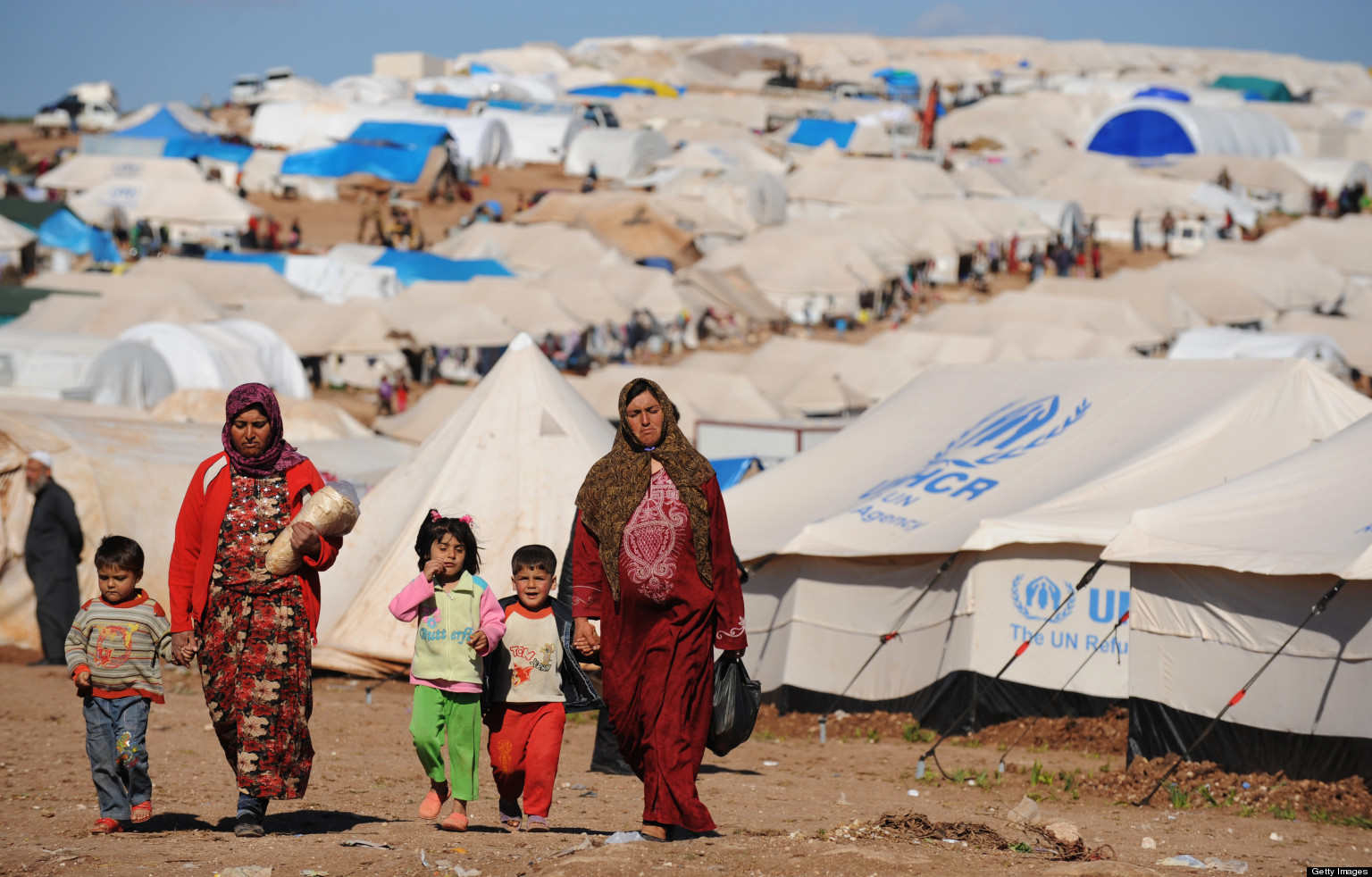
Syrian internally displaced people walk in the Atme camp, along the Turkish border in the northwestern Syrian province of Idlib, on March 19, 2013. The conflict in Syria between rebel forces and pro-government troops has killed at least 70,000 people, and forced more than one million Syrians to seek refuge abroad. AFP PHOTO/BULENT KILIC        (Photo credit should read BULENT KILIC/AFP/Getty Images)


“The mindset that Jews surrendered with their guns is far more important than the hardware turned over: They surrendered the demonstrated intention at all costs, to desist being deprived of liberty” Dr. Keith Ablow, Fox News commentator

Image

On April 1, 1933, the Nazi party called for a boycott of all Jewish owned businesses in Germany. Richard Stern, a Jew, as well as a decorated German veteran from World War I, stood in the doorway of his bedding store, wearing his Iron Cross, and passing out leaflets he had printed condemning the actions of the ruling Nazi party. He was arrested. Fortunately he had friends at the police headquarters who had him released. Richard Stern was my father’s uncle, but in reality his father – his mother’s brother and the man who raised him as his parents were divorced. For all intents and purposes, Richard Stern was my grandfather, a genuine hero who although passing in 1967, inspires me to this very day.

Like most German Jews Richard Stern could not believe that the country in which Jews had lived, prospered and assimilated, would actually become crazy enough to carry out the radical ideas expressed by Hitler and the Nazi party. He had faith in the democratic system of Germany. The Jewish success story in Germany was exceeded only by the Jewish success story in America. He was active in the Social Democratic party, a mainstream party. He had faith that his friends and neighbors, with whom he fought alongside in World War I, would reject the crazy ideology that would eventually lead to the slaughter of 6 million Jews and another 6 million people who the Nazis deemed unfit to live.

The rise of the Nazis began through the German electoral system. They reached the peak of their electoral success in July 1932 when they won 37% of the vote. But Hitler refused to form a governing coalition with any other German political party. So the President of Germany, Paul von Hindenberg, appointed Franz von Papen as chancellor. As Papen could not govern without sufficient support in the Reichstag, a new election was called for November 1932. Support for the Nazi party actually decreased to 33%. Nevertheless, Hitler convinced Hindenberg to appoint him as chancellor. The result was devastating.

Hitler engineered new elections called for March 5, 1933. With Hitler as the head of the government, the Nazi storm troopers had free reign to attack and oppress their political opposition. Just 6 days before the election, the German parliamentary building, the Reichstag, was burned down. Hitler used that to gain special dictatorial powers and further suppressed the voting support of opposition parties. Yet the Nazis still did not win a majority, polling 44 % in the March 5, 1933 elections.

In addition, the initial action against the Jews; the boycott of Jewish businesses, was not very successful. Germans still bought from their Jewish friends and neighbors. No, the real oppression came after a steady campaign by the Nazis to demonize anyone who disagreed with the Fuhrer, who opposed the Nazi party in any way. Indeed, another relative of mine, Emil Romberg of Essen, Germany, was a leader of the Social Democratic party and was beaten to death by the Nazis. So by November 1933 it was no surprise that the Nazis won every seat in those Reichstag elections.

The reign of terror had truly begun.

In September 1935 the Nuremberg laws were passed, institutionalizing a vast array of anti Jewish practices. The Jewish community was stunned. Some realized the need to leave Germany. My mother’s family was able to immigrate to America in 1936. My father, his mother, and Uncle Richard wanted to go to Palestine, but could not gain permission to enter. Most German Jews, however, still clung to the belief that the craziness of the Nazis was a passing phase. Most could not understand how their homeland, the country they loved and to which they dedicated their loyalty, could see them as criminals, as undesirables.

We can, however, learn how this happened. Just visit the museum, “A Topography of Terror” in Berlin. It gives in full detail, with unvarnished honesty, how the Nazis succeeded at convincing a populace to follow the Nazis. Hitler promised to restore the “real Germany,” the one of power and status. He promised to rid Germany of unwanted alien elements. He spoke of true German values and staged massive, extremely effective demonstrations to demonstrate his popularity. He condemned all opposition as disloyal, not truly “German.” By the time of Krystalnacht in 1938, it was a country gone insane. By the way, in this analysis of the success of the Nazi rise to power, guns are not mentioned at all.

The ownership of guns, you see, is pretty much an afterthought in understanding the success of the Nazis in 1930’s Germany. There can be little effective resistance to the brainwashing effects of propaganda when the value of “patriotism” is used to silence political opposition and the shut down the free press. The Nazis did not prevent opposition because they had more guns, but because they controlled the dissemination of information. They controlled the media of the day.

Does any of this sound a bit familiar? I would argue that the ideas being perpetrated by the hard right, the xenophobia about Mexicans and Muslims, the chest thumping patriotism, are far more likely to lead us down the road to Nazism than any proposed or even yet to be proposed gun law. And I say that as someone who is not against responsible citizens owning guns.

Talking about the Holocaust in terms of gun issues is a gross distortion of history. Even worse, it dishonors the memories of those who suffered that tragedy, through the implication that somehow the victims were to blame, that somehow they could have done more than try to survive the confusing times in which they found themselves; that they could and should have been examples of 21st century radical right wing ideology instead of just innocent German Jewish citizens. And, it dishonors the memory of those Jews, who, like my Uncle Richard Stern, did stand up and protest. Enough of the idiotic comparisons that tramples on the dignity of the victims. Enough of rewriting history to suit your political agenda.

So to you, Ben Carson, Keith Ablow and Fox News – just shut up.

IMG_0091

Rabbi Akiba taught that the one who erects a sukkah on the deck of a ship has built a valid sukkah. Rabbi Gamaliel declares it is invalid. Regarding this, the Talmud relates the following story. “It happened that Rabbi Gamaliel and Rabbi Akiba were journeying on a ship during Sukkot. Rabbi Akiba arose and erected a sukkah on the deck of the ship. The next morning the wind blew and tore it away. Rabbi Gamaliel said to him, ‘Akiba, where is your sukkah?’” (Sukkah 23a)

You can almost hear the sarcasm in Rabbi Gamaliel’s voice. He clearly thinks that Akiba is a fool for attempting to build a sukkah on the deck of the ship. So I ask you, based on this story, do you think Akiba’s sukkah was valid or invalid? Well, halachah follows Rabbi Akiba. It also follows him regarding the building of a sukkah on the top of wagon, the top of a tree, or the back of a camel! I am sure that some or all of these strike you as rather silly. So we can ask the question, why are these sukkot valid? (note that the Sukkah on the back of the camel can only be used during chol mo’ed) In fact, why are these examples even considered at all?

The fact that they are discussed in the Talmud shows that these situations did arise. I must admit I am trying to figure out how to build a sukkah on the back of a camel. However, I think the Talmud is pushing us to think differently about a sukkah. Indeed, I would suggest that we are the sukkah. I believe the sukkah symbolizes our physical bodies.

Consider this. The sukkah is not supposed to be a permanent structure. This is evident from a number of restrictions on how it is built. First, it cannot be higher than 20 cubits. Why is this significant? A cubit is the length between the tip of your middle finger and the corner of your elbow. Clearly this is different for each of us. So the upper limit to the height of our sukkah depends on a body measurement singular to each of us. Even more, the taller the sukkah, the more permanent the structure has to be constructed. A sukkah built on top of another one is invalid as well and you can guess a reason – that such a structure implies more permanence than intended. The sukkah should be able to withstand a modest amount of wind, but not built to withstand exceptional winds. Planks can be used for the roof, but not wider than 4 handbreadths (another measurement that is individualized as opposed to standardized). One has to use branches, stalks or stems from plants grown from the ground for the s’chach (roof covering). All of this just reinforces that the sukkah is a very temporary, fragile structure – just like our bodies.

A sukkah is open to the elements. It is subject to the wind and rain. Its roof is supposed to have enough opening that one can see the stars. So it is with our bodies. They are susceptible to the exigencies of the weather, to the whims of nature. However, we live mostly indoors, wear protective clothing and take measures to protect our health. The command to eat and sleep in the sukkah is meant to remind us how exposed we really are, especially when we are not in the comfort of our homes. By simply eating a meal in the sukkah, we become aware of the elements – heat, cold, rain, sun, bugs – in a way different from our everyday lives. Just as the sukkah is open to the world, flimsy walls on 3 sides with one side open, as well as a roof patchy enough to see the stars, so are we supposed to be open to the world. This is highlighted by the practice of ushpizin, the welcoming of guests, preferably strangers, and at least one poor person, into our sukkah. The openness of the sukkah and the welcoming of guests have layers of potential meaning. The pshat or plain meaning is the clear exposure to the elements. Looking a little deeper, are we open enough, willing to share ourselves enough to welcome guests? Or do we shut ourselves off from others? Finally, are we willing to look up and potentially see stars? I view this as a reminder to look beyond our own ideological comfort zone, to open our minds to other ideas and perspectives. The sukkah reminds us that if we are open, things will pass through us easier, we will absorb the winds of change and difficulty better than if we are rigid.

It is taught in Proverbs 20:27, “the soul of a person is the light of God.” God is that eternal light that drives us to bring blessing and righteousness to the world. Our bodies are the physical agent that houses and protects that light. Or, to put it another way, in each of our physical existences is a Divine Presence; that piece of us breathed into us by God – our souls. Yet our bodies are also susceptible to those things that threaten to extinguish the light of God.

Our bodies can also be compared to the mishkan, the portable sanctuary the Israelites carried through the wilderness in which God’s presence dwells. Just as the mishkan was guarded against impurity, so, too, are we instructed to keep our bodies free from impurity. What is impurity? According to the theology we learn from Leviticus, and carried throughout rabbinic times, impurity is anything that repels the presence of God. Impurity can be an act gone wrong or a substance that dims the light of God. When we are participants in a moral wrong the light of our soul dims. When we are exposed to disease, the light of our soul dims. For whatever afflicts the body afflicts the soul while the soul inhabits the body.

The sukkah symbolically reflects this same concern. The Mishnah teaches that whatever is subject to ritual impurity and does not grow from the soil is not allowed to be used in the building of the sukkah (Sukkah 11a). We – who carry the light of God, cannot dwell in a place, even a temporary place, which contains the impure; just as the light of God cannot dwell in a body that is kept impure, physically or morally.

Further, just as the mishkan of our ancestors carried God’s presence through the wilderness, each of us spends most of our time wandering in a wilderness. How much of the time are we truly sure of the path we are travelling? How much of the time are we sure of our moral direction? How much of the time are we sure of our professional direction, our careers? How much of time are we sure of our spiritual direction. While some aspects of our lives seem in order at any given moment, how often do we feel in the wilderness in a different aspect of our life? Just as God asked Adam, the first man, ayekah, where are you, God asks us that question quite often. How many times do we know?

That is why a sukkah built on a ship, a wagon or a camel can be valid. We, our physical bodies, are sukkot wandering in the wilderness, not knowing how the jolts of the journey will affect us. When Rabbi Gamaliel asks Akiba, “Where is your sukkah,” perhaps it is an echo of God’s question to Adam. The Talmud does not tell us what Akiba answered. I would like to believe that Akiba answered that the fact his sukkah was blown away is exactly what made it valid. We can never know where we will be or where the winds might blow us.

The book of the Tanach we read during Sukkot is Kohelet, Ecclesiastes. From here we read, “I have observed the principle that God gave man as his answer. God brings everything to pass precisely at its time; God also puts eternity in his mind, but without man ever finding what is beginning and what is the end of all things God brings to pass. Thus I realized that the only worthwhile thing there is for them is to enjoy themselves and do what is good in their lifetime.” (Ecclesiastes 3:10)

Our sukkot should reflect these values taught by Kohelet. They should be decorated in a way that reflects happiness and enjoyment, with the realization that these, like our own lives, are temporary. We might not know the answers to life’s ultimate questions, but we can show appreciation for the moment in which we exist. We can choose to enjoy that moment. We can choose to do what is good and right. Life simply is, and we can choose to fight it, or to embrace it.

The sukkah built on the ship is valid because each one of us is a sukkah balanced precariously on a ship sailing through the sea of existence. We control very little of that journey, but we can rejoice in having the opportunity to even make the journey. As much as anything, Sukkot is about rejoicing. May this Sukkot bring us a sense of joy, wholeness, and contentment.

Amen


“I forgive, but I won’t forget.” I have reached a point where I shudder when I hear those words. What it really means is, although forgiveness is granted, there are conditions. In other words, it can be brought up and used to browbeat you at any time. Here is what I mean.

At one time during Saul and Ida’s marriage, Saul did something really stupid. Ida let him have it for the deed. Saul apologized and they made up. However, from time to time Ida would mention what he had done. Finally, one day Saul said, “Honey, why do you keep bringing that up? You always tell me that you forgive and forget.” “That’s right,” Ida replied. “I just don’t want you to forget that I’ve forgiven and forgotten.”

Here we are on Yom Kippur – the Day of Atonement. We are at the end of the season of our teshuvah, the process of doing repentance for our wrongs and seeking forgiveness for them. The Talmud teaches us that God always forgives us for sins against God. Yom Kippur is our means to ask for and to receive forgiveness from God for those sins. However, the Talmud then states that for sins against another human, God cannot forgive and Yom Kippur cannot atone unless you go to the person you harmed and seek their forgiveness. If you do that process, God will forgive you. What about the person you harmed? Very little is taught about the requirements of that person to forgive you.

Indeed, we are completing a process that speaks extensively about our relationship with God. Our teshuvah is oriented towards a conclusion in which we can realistically hope to gain God’s forgiveness. However, with all due respect to the ever presence of God, it is not God with whom we have to live. It is not God with whom we must interact every day, at work, at home, at social gatherings and at school. It is other people. I do not worry about God’s mood when I go to bed at night. I do worry about my wife’s mood. It will be a long night if we are not right with each other. I can know with a great degree of surety that God will forgive me for my wrongs. I am not always so sure about my wife, my children, my friends, my congregants, my colleagues…you get the picture. For the truth is, getting forgiveness, real, complete, clean forgiveness from each other is not guaranteed. It is very hard.

You see, we humans are very stubborn. We like to cling to our hurts as they justify our subsequent behavior. Too often we bear our wounds from each other pridefully, like Purple Hearts. We want folks to conform to our standards of behavior. When they do not, even if they apologize, we remember that they did not really live up to our expectations. So we might deign to SAY we forgive them, but in fact, it is just information filed away to use when we see their past transgression working to our advantage. Well, people really do try to change. Many really want to do better, to turn their path, but too often we doubt their motives, their sincerity, and thus dismiss their efforts. We cling to the memory of a hurt they caused, a wrong they did, a statement they misspoke, a promise they forgot to keep. We keep score. We hold grudges.

While there is little in the way of formal halachah, actual Jewish law about the obligation to forgive, there are some great Talmudic stories that teach about the power of forgiveness. I would like to share and discuss one of these stories.

Ta’anit 20a

The rabbis taught, “A person should always be as pliant as a reed, and not be hard like a cedar.” It once happened that Rabbi Elazar, son of Rabbi Shimon was coming from Migdal Gedor, from the house of his teacher. He was riding very tall on a donkey, meandering along the banks of a river, and he was exceedingly happy. He had an inflated opinion of himself because he had learned much Torah. As opportunity would have it, he met a man who was exceedingly repulsive. He said to him, “Shalom Aleichem, my teacher.” He did not return the greeting to him. He said, “Oh worthless one, how ugly is this man. Perhaps all of the people of your town are as ugly as you!” He said to him, “I do not know; rather you should go and say to the artist who made me ‘How ugly is this vessel that you made?’” As soon as he knew that he had sinned, he got down from the donkey and prostrated himself flat on the ground in front of him. He said to him, “I have afflicted you, expunge my sin!” He said to him, “I will not expunge your sin until you go to the artist that made me and say to him, ‘How ugly is this vessel that you have made.’” He was traveling after him until he arrived in his town. The people of his town went out to call to him. They said to him, “Peace be with you teacher, teacher, master, master.” He said to them, “Who are you calling teacher, teacher?” They said to him, “To the one who is traveling after you.” He said to them, “If this is a teacher, may there not be many like him in Israel.” They said to him, “Because of what?” He said to them, “Such and such he did to me.” They said to him, “Even so, expunge his sin, for he is a man great in Torah.” He said to them, “For your sake, here, I will expunge his sin only if he will not regularly act this way.” Immediately Rabbi Elazar son of Rabbi Shimon entered and expounded, “A person should always be as pliant as a reed and not hard like a cedar. Therefore the reed merited that a quill pen be taken from it with which to write the Torah scroll, tefillin, and mezuzot.”

What do you see as the central point of this story? Is it about the sin committed by Rabbi Elazar or the refusal of the ugly man to grant forgiveness after Elazar repents? There are hints pointing at both. Rabbi Elazar is a newly minted rabbi, travelling from his place of learning to his first assignment. Migdal Gedor literally means a “fenced tower” which implies how the place of learning can be an ivory tower. Rabbi Elazar is infatuated with the high thoughts of Torah learning he has carried away from his teacher. So much so that he is disturbed by the interruption of the ugly man and lashes out at him. How many times have we done that? How many times have we been so preoccupied by our lofty thoughts that we verbally strike at the person who dares to intrude on our mental space? By referring to the artist who made him, the ugly man is reminding the rabbi that it is God who creates everyone.

This is like cold water on Elazar’s face, and he quickly realizes his sin. He gets down off of the donkey and literally prostrates himself on the ground in front of the ugly man. The Hebrew indicates it is full prostration, much like you will see me do at the end of Neila this afternoon. The ugly man, however, refuses to forgive him. Instead, he insists that Rabbi Elazar go ask the artist, i.e. God, about his ugliness. This, of course, is an impossible condition for forgiveness. The story hints at who has the moral high ground at each stage. When Rabbi Elazar is on the donkey, thus physically higher than the ugly man, the ugly man is on higher moral ground. BUT, when Elazar prostrates himself, doing full teshuvah, and the ugly man refuses to forgive him; their physical and moral positions are reversed! We begin to think the ugly man is being unreasonably stubborn. It takes the community to convince him to finally forgive the rabbi.

Rabbi Elazar, having learned an important lesson, closes the story by repeating the maxim that opens it, but adds an additional element. The importance of the reed is highlighted by its connection to being the material for a pen that writes Torah, tefillin and mezuzot. Why the reference to those three things? Because each contains the same passage from Deuteronomy 6 – the Sh’ma and V’ahavtah, which begins you shall love Adonai your God. How do we show love for God?   By following the commands of Torah about how to properly treat each other. So we get a complete lesson. We are to be flexible like a reed, ready to learn, both when we are wrong and do teshuvah as well as when we are ready to forgive another who is sincerely repentant.

But is that really the end of the lesson?

Like so many of the great Talmudic stories we are challenged to consider who we are in the story. Are we the unthinking rabbi, who is so enamored with his own self importance that he spews an insult at an innocent man? Or are we the stubborn man – in truth ugly because he is refusing to forgive the person who hurt him but is now truly repentant.

There is another, very powerful way to read the story. Notice that the ugly man is unnamed. Notice also that Rabbi Elazar is named only at the very beginning of the story as well as the very end. When you read the story, the pronouns become quite confusing as to whom they are referring – the rabbi or the ugly man. Perhaps, then, they are one and the same. The rabbi, riding blissfully along the banks of a river, confronts the ugly part of himself, the part that contains doubt about his ability to serve a community. He can forgive himself only after arriving in the community and sees he must act on their behalf.

Each of us has our ugly man, our dark side, our regretted actions, our warts, our pits of despair. We cringe from confronting them, afraid that they are too terrible to forgive. On my 31st birthday, I received a phone call from my childhood friend, Helene. While growing up our families always had seder together. Helene was like the sister I did not have. She called ostensibly to wish me a happy birthday, but I noticed that her voice sounded strange, flat, unaffected. This was a person who was usually joyful, animated. When I asked her mother what was wrong, she said that my friend was in depression, but not to worry as the therapist said all was under control. A week later she turned up missing. After a day of no news I suggested to her sister that we fly up to Boston, where Helene lived, and start to look for her. So we did. Before leaving a friend who was a psychologist told me what to look for in her apartment that would be signs of a possible suicide. When we walked into her apartment, it looked like a textbook case of someone suicidal. The place was in shambles. Coins piled everywhere, multiple checkbooks and bank accounts strewn around. I found a journal in which she berated herself for her perceived failures. On the second day of searching we got the news. Helene had returned to her mother’s house, sneaked into the basement when no one was around, and shot herself in the head. I see her call to me as a cry for help. To this day I wonder if I could have changed her fate by reaching back to her more quickly and directly.

Yes, we have a hard time forgiving each other. But sometimes the hardest person to forgive is our self. Sometimes that ugly aspect of the self erupts at the most inopportune moment, pushing us into doubt, anger, even depression. Sometimes what angers us about the actions of others is that they reflect something embarrassing or difficult in ourselves. Our inability to forgive their action derives from our own shame, our own anger at being reminded that WE have that flaw, that defect, that need. So we tell them we forgive them, but cannot forget! We cannot forget because that shame is one we are bearing. We cannot forget because our own actions mirror the hurtful deeds of the other.

So here is the third aspect to the story. Rashi says the ugly man is actually Eliyahu Hanavi, zecher letov, sent by God to teach the rabbi a hard lesson. Perhaps the ugly man is not merely Rabbi Elazar wrestling with the ugly aspect of himself. Perhaps the ugly man is there to show Rabbi Elazar that all of the ugly aspects he sees in others are actually present in himself. When the ugly man tells Elazar to go talk to the artist who made him, he (Eliyahu) is trying to teach Elazar that God made them both, and they are dopplegangers – mirror images of each other. Elazar needs to do that work on himself. He needs to reflect on himself, to understand himself, and finally, to accept and forgive himself. Then, and only then, can Elazar, indeed can any of us, truly forgive the others around us.

Today is Yom Kippur – the day of atonement. But the word kapeir not only means to atone, but to forgive. We have been working hard on our teshuvah, our process of getting right with God. Many times we will recite the words, V’al kulam Eloha selichot, s’lach lanu, m’chal lanu, kapeir lanu, “for these things God of forgiveness, forgive us, expunge us, grant us atonement. May we come to see Yom Kippur not only as our day of Atonement, but our day of forgiveness as well. May we not only gain forgiveness from God, may we also forgive ourselves, leading us to forgive each other. Kein yehi ratzon, may that be God’s will.


Street Art


IMG_0419

Whenever Audrey and I travel to new or interesting city, we love to take walking tours. They are a great way to gain insight into a city, to learn interesting bits of its history and culture. A walking tour can surprise you with really great information about topics you never considered. In June, we spent 5 days in London. We have been to London before. The primary purpose of this trip was to see The Moody Blues in concert. They were, of course, fantastic. The big surprise of the trip was how much we enjoyed and how much we learned from a walking tour we took – of the street art of London.

I know what many of you are thinking – street art? Isn’t that just a fancy name for Graffiti? That was exactly what I thought until I took this walking tour. I only knew Graffiti as words and pictures spray painted on the sides of buildings and, in certain cities, subways. I learned there is so much more to Graffiti than that. Street art has many elements I never considered. First, it employs numerous media other than cans of spray paint. Second, it is not random vandalism. Much of it is well thought out social commentary by serious artists. Third, it is a culture that exists internationally. Many street artists travel from city to city, each leaving behind their unique signature or “tag” along with a very creative piece of art. Last, not all street artists are just poor folks expressing outrage at their circumstance. Many have utilized their art and subsequent reputations to become quite successful, even famous – yet sometimes still anonymous!

When and where did Graffiti begin? Well, in doing some research I find there is no single agreed upon answer. So I will try to cobble together a history integrating some of the various sources and versions I found. I guess you might say the early cave man engaged in a kind of street art, by producing etchings on the walls of caves – but we cannot know if they secretly contained any political messages. There was some writing on building walls with simple pictures in ancient Rome. But perhaps we should consider the first real contemporary Graffiti artist was whoever started the “Kilroy was here” craze in World War II. You can see an example of this in the first image on the page I have distributed.

KroySquare

There are numerous legends as to who this was. Perhaps it was shipyard inspector James J Kilroy who scratched the words on the bulkheads of ships he inspected. Other legends include a Boston Red Sox fan who became an American GI in World War II. Others say it was a navy admiral. In any case, you probably recognize the drawing that accompanies the words – a long nose and eyes peering over a wall grasped by two hands.

Perhaps the first real Graffiti artist was a fellow from North Philadelphia by the name of Darryl MacCray. At age 12 MacCray was sent to a youth development center in Philly, where he earned the nickname “Cornbread.” This youth center was filled with street gang members who would paint their gang names on the walls of the center. MacCray began tagging his name “Cornbread” next to the gang names, thus becoming the first person to tag his own name on walls. He was released from the youth center and attended Strawberry Mansion Junior High, where he developed a crush on a girl named Cynthia. In order to win her affection he began to paint “Cornbread loves Cynthia” all over Philadelphia – thus starting the practice of tagging. In 1971 a Philadelphia youth was killed in gang warfare and the papers incorrectly identified him as Cornbread. Cornbread began tagging “Cornbread Lives” all over Philadelphia, including on the private jet of the Jackson 5 parked at the Philadelphia airport. He was eventually arrested for painting “Cornbread Lives” on an elephant at the Philadelphia Zoo!

In the 1970’s Graffiti spread like wildfire to New York – where the subway system became a rolling paint canvas for Graffiti artists. Their work became more and more creative. A famous picture from the film “Saturday Night Fever” shows John Travolta sprawled in a subway seat surrounded by Graffiti. It seemed like the more New York authorities tried to clean up the subways, the more prolific the artists became – and so the more sophisticated their work as well.

In 1981 Xavier Prou, using the pseudonym “Blek le Rat” introduced Graffiti with a decided French style to Paris. He was influenced by the Graffiti of New York, but created a different, more European style. He is credited with doing the first full size Graffiti stencils. Some of his work has been preserved in museums, including his gorgeous stencil of a ballerina. Blek le Rat drew his name from the comic book character Blek le Roc, but “rat” was his anagram for “art.” The greatest influence of Blek le Rat, however, was his motivation for doing street art. Much of it was sharp political and social commentary. He also felt that by bringing art to the street, he was bringing it to the people. Indeed, he was arrested in 1991 while stenciling a copy of a famous painting.

Today, the street art culture is international, diverse, sophisticated, and still very much rebellious against political and social norms. A number of its participants have become quite successful, quite famous. For example, one of the artists whose work we saw on the streets of London was commissioned by Obama to create a piece for the White House as well has hired by Luis Vuitton to design a line of scarves. However, the most famous, most successful member of the street art culture is Banksy. No one knows who Banksy is. He has never revealed himself or been caught. Yet, by now he must be a multi millionaire. One day Banksy appeared anonymously in Central Park selling small paintings. He sold 3 for 60$ each and signed them. He then posted on his web what he did and that those 3 paintings were 3 authentic, original signed Banksy paintings. Their worth now – $200,000 each!

Despite his success, Banksy has not lost his social conscience. Recently, on a water tank on the edge of the Pacific Coast Highway that Banksy thought was abandoned, he painted a caption on the side “This looks a bit like an elephant.” It instantly turned into a tourist attraction. Two owners of a media company decided to turn it into a money making attraction and bought it from the city of Los Angeles, with the idea to sell it for a fortune. However, a homeless person had been living inside of the tank for 7 years. Banksy heard about this and gave the man enough money for an apartment and food for a year. He then removed the water tank from his web site, thus it was no longer authenticated and worth only what it would fetch as scrap metal.

His most recent undertaking is in Somerset, England. Banksy invited 60 artists to join him in creating “Dismaland,” a very eerie spoof on Disneyland. Called a “bemusement” park, it is advertised as not appropriate for children. It has just completed a 5 week run in which 4,000 tickets were made available for each day. Local residents were told that an abandoned amusement area in the neighborhood was being used by a Hollywood firm to film a crime movie. Just Google “Dismaland” and you will get an appreciation for the extent of these artists’ work as well as the very sharp social commentary.

My very favorite Banksy prank, however, is one he pulled on the British Museum in London. He placed his own work in the ancient artifacts section.  It took museum officials 3 days to realize it was a fake piece that did not belong there. Here is a picture of that piece.

images

We saw two Banksy works during our walking tour of London street art.

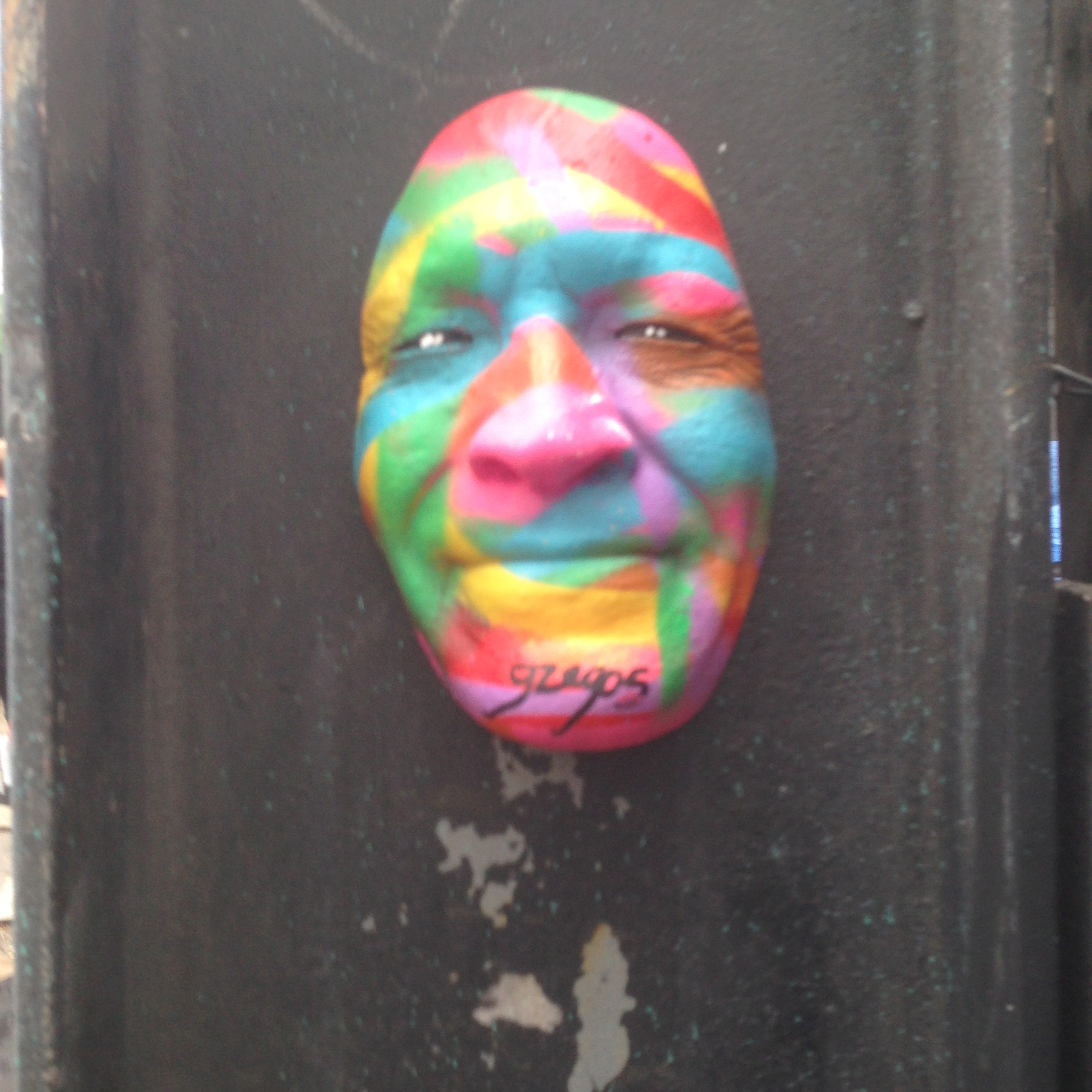
Which brings me back to some of the fascinating things we learned on that tour. First, street art is not just random spray painting. It is purposeful, well thought out creations that reflect the perspectives and missions of the artist. That purpose might be social commentary, a political statement, or just to amuse. Indeed, one of the artists whose work we saw says his purpose is just to bring smiles to all who view his work. The picture we saw of his is a whimsical painting of a serious bird watcher with a duck sitting on his head. As I said before, this is an international movement. Some artists travel around the world leaving their signature work in many great cities. One French artist makes impressions of his face, paints them, and places them on walls all over the world. Each mask is made from his face, yet each is different. Here is what we saw.

IMG_0426

Third, the materials now used are extremely diverse and demonstrate how hard it must be for the artist to get quality work up quickly and in secret. This piece is amazingly impressive as it is done on a rough brick wall. The artist spread a plaster over the wall, then chiseled out the face. That is quite a process yet look how sophisticated the end result is.

IMG_0414

Finally, despite the beauty of so much of the art we saw, it can all be gone in an instant. Much of the street art is done on abandoned buildings that are about to be torn down. Much of it is on buildings about to be renovated. Much of it is placed in places that irritate municipal authorities, as they have other plans for a neighborhood or building. So the overwhelming percentage of street art just disappears. Yet, I say with admiration, this counter culture continues to grow in extent and sophistication, adding a beautiful spice to the life of the world’s great cities.

By now you might be thinking – all of this information about Graffiti is very interesting, but what in the world does it have to do with Yom Kippur? Well, think about this. Some of the street art is amazingly beautiful – yet it will disappear when the building is torn down or the wall is painted over. Some of the street art is an expression of rebellion – yet it will disappear when the building is torn down or the wall is painted over. Some of the street art is poignant insight into life and culture – yet most of it will disappear when the building is torn down or the wall is painted over. Some of the street art is just a mediocre prank – yet it will disappear when the building is torn down or the wall is painted over. Some of the street art can change our perspective on its subject – yet it will disappear when the building is torn down or the wall is painted over. Some of the street art makes us angry – yet it will disappear when the building is torn down or the wall is painted over. Some of the street art will make us happy – yet it will disappear when the building is torn down or the wall is painted over. Some of the street art will make us laugh, some will make us cry, some will prod us to think, some will make no impression at all. All of it will eventually disappear. Yet the street artists keep on creating, keep on sharing their art, their perspectives despite the fact it will likely disappear quickly.

My friends, each of us is a piece of street art. Each of us can make another person laugh or cry, angry or pleased, happy or sad. Some of us will make a huge impression on society with the art we call our lives. Some of us will only affect the circle of our family and friends. Some of us are political protesters. Some of us are artists. Some of us just meander through life. Some of us do everything with focused purpose. Yet all of us will disappear. Like the art that is randomly placed on the walls of buildings or the sides of subways, our lives will end – some after a long time, some shorter. Some of us will die by disease, some by accident, some by murder, some tragically, some peacefully. We cannot know our end, but we can know what we are doing in this moment, in the now, with the art that is each of our lives.

That, my friends, is Untaneh Tokef – the prayer we recited on Rosh Hashanah and will recite once again tomorrow morning. It is a prayer of fatalism, teaching us that whatever designs we might have for our lives, it can all end in an instant, and in a way we are unlikely to predict. Like the work of street artists, we are temporary creations of the Divine Artist. Unlike the work of the street artists we are deeply aware of our mortality as well as our potential for deep meaning and purpose. So tonight I ask you these questions: are you happy with the work of art you are creating through the actions of your life? Can you accept the reality that one moment you will no longer be here, that your life, like a work of Graffiti will disappear? Are you creating a work of art that might make a lasting impression, a lasting memory? Not necessarily in the sense of being famous, but have you made a difference in another person’s life?

For each of us is not only a work of street art created by the Divine Artist; each of us is also an artist, continuing the work begun by God. That is the message of Untaneh Tokef, indeed of the observance of Yom Kippur. To a certain extent our lives are bound to a fatalistic path we do not control. Yet, we can make slight but significant adjustments to our paths. Our prayers tell us this is done through teshuvah, tefillah, utzedakah, repentance, prayer and righteousness. We likely cannot change the hour of our appointed departure from life, but we can change the quality of the time we have. We can improve the artistry of our lives.

And we need not do it alone. For unlike the works of art that adorn the sides of buildings and subways, we have the ability to reach out to each other, to help each other, to build community. We might be as diverse as street art, but together we can laugh, cry, celebrate, mourn, confess and pray. Together we create something greater than any of us alone. Despite our differences, we can choose to hold a hand, to embrace in a hug, to share our tallit with the person next to us. We can choose to elevate each other.

Uvshofar gadol yitaka – the great shofar is sounded. V’kol d’mamah dakah yishama – yet it is the still small voice that is heard. No matter how loud any of us can speak, in the scheme of life it is but a tiny voice. Each of us is a still small voice.   And that voice, well, it is the voice of God, the same voice Elijah heard while alone, contemplating the artistry of his own life. May each of us hear the voice of God in our own still small voices. May each of us be at peace with the artistry of our lives. May each of us take joy in the artistry of the lives of each other. May we turn fear to awe. May we turn anger to celebration. May we all be blessed with a year of shalom, of wholeness, completeness and peace.

Amen

Tree of Life


search


There is something mystical about trees. Where there are trees there is life, there is activity. Forests are places where magic occurs. They are laden with mysteries. Think of all the wonderful stories that take place in the woods. Think of the breath taking majesty of walking into Yosemite or Muir woods in California, and standing next to redwoods that remind us of how tiny and insignificant we are. The youngest trees express their ages in decades, others, like the great oak trees, in centuries. The ages of others, like the redwoods and sequoias, are measured in millennia. If you look at the grand oak tree in Thomasville, for example, you can imagine that it was there, growing, even before our country was created. Trees are a poignant combination of permanence and fragility. So many have existed far beyond our lifetime. Yet we can destroy them in a heartbeat.

Our relationship with trees does indeed say much about our relationship with the world – and Jewish literature confirms this. In Deuteronomy 20:19, Torah tells us that when besieging a city, one can eat of the fruit of trees, but the armies cannot cut them down. The destruction of trees represents the destruction of an existence far beyond ours; which can have devastating consequences. Midrash Kohelet Rabbah tells this story. After God created Adam and Eve, God took them around the Garden of Eden showing them all of the trees. God then said to them, “Behold My works, now beautiful and commendable they are! All that I have created, I did for your sake. Pay heed that you do not corrupt and destroy My universe, for if you destroy it, there will be no one to repair it after you.”   Trees are sustainers of life. If we destroy them, we choke off life.

We use trees to express many ideas metaphorically. “We cannot see the forest through the trees” means we cannot see the big picture because we are so focused on details. When we ask if a tree falls in the woods and no one is around, did it really make a sound; we are posing the question about what is real and what is not. Here are some quotes about trees that range from funny to profound. Chris Maser wrote, “What we are doing to the forests of the world is but a mirror reflection of what we are doing to ourselves and to one another.” Ralph Waldo Emerson said, “The creation of a thousand forests is in one acorn.” Chad Sugg said, “Love the trees until their leaves fall off, then encourage them to try again next year.” FDR said, “Forests are the lungs of our land, purifying the air and giving fresh strength to our people.” And finally, my favorite, by Jarod Kintz, “Love is like a forest, I think as I kill trees by squandering toilet paper while ‘decorating’ my ex girlfriend’s front yard.”

Maya Angelou, in her poem “When Great Trees Fall,” compares trees to human souls, and the falling of a great tree to the death of a beloved person. Indeed, some literature poses the idea that trees have souls. Far from being inanimate objects, trees are organisms with their own personalities. Shel Silverstein’s book, “The Giving Tree” is at once a sad but beautiful metaphor for how some of us only give while others merely take out of life. It is also a controversial book as some see the tree as a metaphor for the role of women being only to meet male demands, never questioning or caring about themselves. However you interpret Silverstein’s book, the tree is a source of life. That is how Judaism uses the metaphor of the tree – it symbolizes life, very specifically life through the words and teachings of Torah.

Which brings us to the window that now graces the front of our sanctuary. You will recognize the words across the top, Eitz chayim he lamachazikim ba, “It is a tree of life to those who cling to it.” We sing those words every time we place the Torah back into the ark, they are from Proverbs chapter 3. The creator of the window is the Master Craftsman studio from FSU, led by Ken von Roenn. Ken, along with Sarah Coakley, came to a Simchat Torah service 2 years ago and watched as we unrolled the Torah scroll around the sanctuary. We had already spoken with Ken about the metaphor of Torah as a “Tree of Life.” He was moved by the sight of so many of our congregants holding up the Torah as it stretched around the sanctuary. Thus Ken designed the image of the tree with a myriad of hands blended into the tree, symbolizing our congregation holding onto a tree of life. Chris Horne is the artist who carried out the design. Ken and Chris are with us tonight. The window had initially been dedicated by Len and Sandra Lichtenfeld, who have been members here and attending High Holiday services pretty much since I arrived here in 2001. So we cannot let this moment pass without thanking Len and Sandra for their generosity to our congregation.

The window was installed in July, and since then I have come into the sanctuary to stare at it numerous times. It is much more than a masterful work of art. And it symbolizes much more than the Simchat Torah service that inspired Ken to create this particular rendition of an Eitz Chayim. It spurred me to look into our traditional texts and explore the extent of meaning and symbolism of the concept of a “Tree of Life.” Why has that come to represent Torah? What does this tree, this particular representation of our hands holding onto a Tree of Life say to our congregation?

We learn from Genesis Rabbah (15:6) that the tree of life was planted in the middle of the Garden of Eden. It is important to note that its fruit was NOT forbidden to Adam and Eve. The only fruit forbidden to Adam and Eve was from the tree of knowledge of good and evil. This causes Philo to wonder why they did not eat from the fruit of the Tree of Life, as opposed to eating fruit from the one granting knowledge of good and evil. This choice seems to represent a basic flaw in humanity – our failure to see things clearly, to overcome the choices that seem satisfying in the moment in lieu of those with long term benefit. Maimonides sees this choice as dooming humanity to an over focus on moral issues as opposed to matters of truth and fact. We now spend too much of our time wading through moral dilemmas instead of learning and understanding the real nature of God and the universe.

The Tree of Life, placed in the center of the Garden of Eden, reminds us of something about ourselves. We often overlook the powerful and the profound for the sake of immediate gratification. This costs us in untold measures. For it is also taught that the Tree of Life it is the basis for the world. Midrash says its branches extend over the whole world, covering the equivalent of a 500 year journey. Additionally, all primeval waters branched out from the streams feeding this tree. As opposed to the tree of knowledge of good and evil, which grants something temporary, the Tree of Life provides that which is eternal, foundational. All of Judaism might then be understood as a human attempt to find our way back to the Tree of Life. We yearn to understand that which is eternal and life giving. It is our moral shortcomings, our tendency to pursue that which is pleasurable but fleeting that trips us up.

Why do we call Torah a Tree of Life? Torah is also seen as a foundational component of creation. In the Book of Proverbs, the quality of wisdom is interchangeable with Torah. The entire book stresses the need to acquire wisdom by studying Torah. A midrash on chapter 8 of Proverbs teaches that when God created the world, God needed a blueprint for creation, much like an architect needs a blueprint for a building. Torah was the blueprint God made to guide creation. This is not necessarily the same Torah we have in our ark, but a supernal Torah, of which ours is a mere refraction, a doorway into the supernal Torah of God. This is a significant idea on a number of levels. First, the Torah we know is less about physical specifics and more about moral law and justice. So God’s guiding Torah includes moral nature and ethics. Morality and justice are the eternal components of Torah, as opposed to any physical properties it describes. Maimonides however, would say that the most important aspects of God’s supernal Torah are science, mathematics, and philosophy; which he sees as the keys to the way the universe ticks. These foundational realities, of physics and of morality, are appropriately called a Tree of Life.

The rabbinic sages saw other ideas as well. In Ta’anit 7a, Rabbi Nachman ben Isaac says we call Torah a tree of life to teach that just as a small tree may set fire to a larger tree, so it is with scholars. Younger minds can sharpen the minds of their elders. Ergo the image of a tree reminds us to always create a knowledgeable next generation. In Baba Matzia we are taught that the works of the righteous are the fruit of the Tree of Life – which is Torah! Our deeds, when they are righteous, are the fruit produced by the tree of Torah. The Zohar takes a different approach. The Tree of Life (Torah) counters the influence of the tree of knowledge of good and evil. The Shechinah, God’s presence, is able to better enter this world, to be with us. The Tree of Life reduces the confusion caused by false gods. Lurianic Kabbalah depicts the Tree of Life as a progression of emanations from the Divine infinity called Ein Sof to our physical world. Each emanation, for example justice, mercy, strength – represents a manner in which we experience God. Each of these teachings, whether Talmudic or mystical, point to Torah as the center, eternal, anchoring presence in our lives.

Which now brings us to our window. I hope each of you will take time over the High Holidays to come up and study this wonderful work of art. For now, let me give a description. Unlike many artistic renderings of a Tree of Life, this one shows an elaborate root system. It is important to note that the exterior of the roots are different in texture than the trunk of the tree. They seem smooth and bare whereas the trunk is rough and textured. The top of the tree, what appears to be the leaves, is a gradation of shading from deep green to deep orange red. One can see 4 distinct colors, which reminds me of the 4 seasons of the year, and how a tree changes color as the leaves age and prepare to fall off. The most striking yet at the same time most subtle aspect is the hands – of different shapes, pointing in different directions. From a distance they are barely discernable, as their colors blend into the background of the tree. Yet they are absolutely distinct, for you can see they are layered onto the tree, not a flowing, smooth part of the tree.

As I said, Ken was inspired by the sight of many of our hands holding up a Torah scroll unrolled around the sanctuary during a Simchat Torah service. The hands in the tree represent all of our hands participating in a ceremony involving the Torah. As I study the window, I see much more. I see this window as a representation of the life and fiber of our congregation. Our Eitz Chayim is not only the Torah of Jewish tradition, it is the special Torah of our congregation.

Start with the roots. Our tree has a root system that is strong, complex, and deep. On one level that symbolizes the Judaism all Jews practice today. While every branch of Judaism is different, indeed every Jewish congregation is different, all Jews are deeply rooted in Jewish tradition. We share the same past. The roots are bare, plain, as they show what is common to all of Jews. The Jewish roots are our history, highlighted by revelation in which we become the people chosen to receive Torah. All of us, whatever our personal practice of Judaism, descend from that common root. If I personalize the tree to Temple Israel, I see the roots as the dedication of the founding families, Blocks, Fleets, Gibbs, Mendelsons, Noveys, Rosenbergs, Turners – all of whom are still part of this congregation, some into the 4th generation. We are anchored in their work, their effort to create Jewish community in Tallahassee. We are strong because those roots are strong.

The trunk of our tree is rough, a different texture than the roots. This enables it to withstand the storms of history, to protect the heart of the tree. For Torah, the trunk is the generations of Torah scholars who study, reinterpret and make Torah relevant for a new generation of Jews. Our trunk is the generations of rabbis, especially Rabbi Garfein and his 35 years of service to Temple Israel, as well as the generations of lay leaders, including all the presidents whose names are on the plaques in the hall. These leaders, lay and professional, have guided this congregation through good times and bad.

The leaves are shown in gradations of four basic colors, green, yellow, orange, and red. If we see these colors representing the seasons of the year, then it symbolizes the cycle of reading and learning Torah, parashah by parashah, throughout the year. But I see an additional way to read the gradations of colors. Our sages teach there are 4 levels to studying Torah:

Peshat– this is the plain sense meaning of the words – the stories on their literal levels.

Remez – this is the hint of something more, the possibility of deeper meaning in the text.

D’rash – means “demand” or “explanation.” It is the push to find meaning beyond the simple and to apply that meaning to our lives.

Sod – the hidden or mystical meaning of the text. This is the deepest layer of interpretation, the result of the most intensive study.

We can appreciate Torah on any of these levels. The 4 beginning letters of the 4 levels are an acronym spelling pardeis, which means “paradise.” If we delve into all 4 levels of Torah learning, we have entered paradise.

Since the tree represents our congregation, the 4 shades of the leaves as well as the various gradations, represent the many ways our congregants experience and relate to our community. Whether you are a service goer, or a person who loves to learn, or someone committed to community service, or a seeker of community and a social life – or any combination of those – you are part of the tree. Wherever you fit in the fabric of the Temple Israel community, you are part of the tree. We are a better, more lush tree when you are here. We feel your absence when you are not.

The hands, well, they are meant to be our hands, in all of our variety. At first I thought of them as leaves, but then I realized that we are the fruits of the eitz chayim, the tree of life. Each of us, however different we might be, is a product of this tree of life. Each of us, whether we have been part of Temple Israel for a lifetime or a week, bears some influence, some impression from this tree. Yes, these hands are our hands, the fruit of the tree. Think about the array of things our hands hold as part of this tree: some hold siddurim (prayer books), some hold the fringes of a tallit in prayer. Some hold musical instruments that help to enable our prayers. Some hold books in study sessions. Some hold tools while putting up the giant menorah or building a temple project. Some hold hot dogs for kids and parents on Sundays. Some hold meat slicers, cutting our sandwiches for the festival and some create the baked goods for the festival. Some hands serve food at the shelter or deliver meals for meals on wheels. Some aid Alzheimer’s patients every Wednesday. Some hold the hands of little children some assist the elderly. All of our hands, I would hope, reach out to other hands, to welcome them to our tree.

Eitz chayim hi l’machazikim ba – It is a tree of life to those who cling to it. Those are the words in our window. Those words from Proverbs 3:18 grace the top of our window. You already know the rest of the verse, v’tomcheha m’ushar, and its supporters are made happy. It is then followed by Proverbs 3:17 – d’racheha darchei no’am v’chol n’tivotecha shalom, “its ways are ways of pleasantness and all of its paths are peace.” May this new year of 5776, be a year in which each of us finds where we are in this tree of life we call Temple Israel, may our hands touch other hands, be it in the spirit of prayer, study, service or friendship. May all of our ways be pleasant ways, and may we all come to know peace.

Shanah tovah u’metukah.

Mark Twain disdained moralizers. He criticized preachers who exhorted people on proper morals; exhibiting what Twain considered to be obnoxious behavior.   He dismissed the threats of eternal reward or punishment by asserting most of the people he would prefer to spend eternity with were not in heaven, concluding, “Heaven for climate, hell for society.” Yes, Twain was a cynic, especially when it came to faith in human behavior. “Always do what is right,” he once wrote. “It will gratify half of mankind and astound the other.” Twain wrote and spoke a lot about morality. He grappled with understanding it, where it came from, how humans so often failed at it. He reveled in picking apart humanity’s moral contradictions. I love this analysis of our moral sense. “There is a moral sense and an immoral sense. History shows that the moral sense enables us to see morality and how to avoid it, and the immoral sense enables us to perceive immorality and how to enjoy it.”

I will admit to often sharing Twain’s cynicism about human nature. Much more than that, however, I share his curiosity as to how we make moral judgments. What is it that drives our moral thinking, our moral choices? On what is morality based? How much of it is instinct and how much is driven by rational thought? Why do we often disagree so profoundly on what constitutes moral actions? Religious people typically see the basis of morality in Biblical teachings. We regard the Torah (or the Bible) as a book if not given by God, then at least divinely inspired. Ergo the moral imperatives outlined in it are seen as basic, as foundational. To follow that morality is a rational choice each of us makes. Indeed, the traditional mitzvah system in Judaism, our ability to choose or not to choose to do mitzvoth is based on faith in our rational selves – the ability to think and reason.

Biblical morality is also a source of great conflict. Fundamental readers of the text see it as immutable, unchangeable. More liberal readers of Bible see it as a guideline that shifts and changes with each new human era. The current discussions over the Supreme Court’s decision in June, supporting the right of same sex couples to marry, typify this debate. Religious opponents of the decision say the Bible mandates that marriage can only be between a man and a woman. They point to numerous Biblical passages for support. They use these passages to indicate the sanctity of the male/female relationship for procreation. They find passages that show same sex relationships as unholy. Supporters of the decision read the Bible differently. They accuse their opponents of being fundamentalists who try to live in an all or nothing Biblical world. Why, they ask, do opponents of same sex marriage insist on following the sexual rules in Leviticus 18 and 20 but shun the food restrictions in Leviticus 11. They say the Torah teaches fair treatment of all humans. Christian supporters of same sex marriage talk about Jesus’s love for all people. They say that if God created the world, then homosexuality is part of the world and we must accept it.

Opponents to same sex marriage base their moral stand on the values of purity/sanctity and respect for divine authority. Proponents base their stand on the values of fairness and caring. Each camp can make a strong case for their position through Biblical citations. Charges are thrown back and forth. Those we call liberal accuse opponents of same sex marriage as being “intolerant.” Those we call conservative accuse supporters of same sex marriage as being moral relativists. This is a useless argument. Each side is actually speaking a different moral language. Each side is holding up a different value as the key moral foundation for making ethical decisions. I will also point out that contrary to the typical modern Jewish perspective that logic and intellect drive our moral decisions, these stances are gut and instinctive. Neither side is prepared to accept the logic underlying their opponent’s view. Now I would wager there are already some of you who are experiencing the stirrings of an instinctive angry reaction to my words, because you perceive I am giving credence to the side of the same sex marriage issue with which you disagree.

So, it is time to conduct a little survey. I will describe a value and ask if you consider it a primary value for making moral decisions or a secondary value, or not relevant at all to moral decision making.

  • Care/Harm – this is the desire to help those who are weaker or less fortunate. It might be care for children or giving aid to a starving family.
  • Loyalty/Betrayal – this is allegiance to the group. In this value there is no tolerance for traitors to the group.
  • Liberty/Oppression – This is the desire to ensure freedom for both yourself and for others. The oppressor might be an individual, like the schoolyard bully, or a government.
  • Authority/Subversion – this is recognition of and respect for the authority of leadership and the institutions that maintain the moral exoskeleton. This includes a respect for hierarchy.
  • Fairness/Cheating – outcomes need to be fair. Games should not be rigged and honest effort should yield honest results.
  • Sanctity/Degradation – this is the need to sanctify some things as “untouchable” or inviolable; or to stay away from others as impure or polluted. This creates a sense of some things as sacred.

If care, liberty and fairness are your top 3, then you are likely a political liberal. If you see authority and sanctity as a basic value in making moral decisions, or you see all 6 as roughly equal, you are likely a political conservative.

How do I know this? Jonathan Haidt is a moral psychologist at NYU who has been doing research on the basis of morality and our moral decision making for over 25 years. His book, “The Righteous Mind” teaches two very important points. First, that moral decisions are driven primarily by our hearts, by instinct – not by our intellect. Our rational selves can sometimes modify decisions but only after something influences our hearts to be open to another possibility. He describes the heart/mind relationship as a rider on an elephant. The rider is our intellect and the elephant our intuition. One would think the rider is in control, but actually the rider serves the elephant by rationalizing the elephant’s intuitively driven moral direction. That is why those on either side of the same sex argument do not listen to the logical arguments of the other side. Their elephant is in charge and the rider just uses its logic to justify its pre-determined moral stance. We know what we want to believe so the rider re-arranges the information to arrive at the conclusions we prefer.

Second, all of the qualities I described to you have been identified by Haidt as moral foundations that serve as the basis for our moral conclusions. A combination of our genetic heritage and experiences from childhood to early adulthood determines to which of the moral foundations we connect. This is our instinct, our heart. This drives, for example, how we interpret Biblical text, ergo how we react to various moral issues when referencing the Bible. The most influential way to get our “elephants” to make a slight shift in their moral direction is through personal relationships. When we meet someone we like who thinks differently than us, our intellect is able to get our heart to consider something new. Most of us have already experienced this. We are seldom swayed by someone else’s logic. But if we get to know them, we are open to considering their perspective. Our desire to connect with others is an instinct that helps us to change.

Most of you know that I participate in a monthly program called “Faith, Food, and Friday” along with 4 other local clergy. My stance on same sex marriage is rather different that 3 of the other 4 panelists. However, because of the personal friendship – the love and respect I have for each of my colleagues – I accept that they cannot believe what I believe. The moral foundations guiding their positions are different than mine. I will defend their right to set policies for their churches. I also very much believe that they respect my position as well.

Most of the time, however, we cling to our predisposed moral foundations. Often we see these in opposition to other’s moral foundations. This is the basis for a lot of political disagreement. For example, liberals often express caring for downtrodden people outside of America. Sometimes conservatives see this in light of the moral foundation of loyalty. Conflict ensues with each side claiming a moral high ground. In truth, there is no high ground. Rather, it is a difference in the perceived importance of a moral foundation. Liberals do not place the same importance on loyalty as conservatives – if they see any importance in it at all.

While all of this is interesting, I think the most interesting aspect is how this knowledge about moral foundations affects the way we interpret Torah. Jewish tradition, certainly the rabbinic tradition of the past 2,000 years, is not satisfied with the plain sense meaning of the text. Our tradition delves for lessons beyond the simple words. It is appropriate to ask about any passage in the Torah – what is this really teaching us? Why is this part of the text? I would suggest that the Torah’s commentary on morality goes far beyond the obvious meaning of the various moral directives. Rather the Torah challenges us, as it has challenged every generation of Jews for over 2,500 years, to look deeper at any passage to see what it teaches us about ourselves and how we should live. There is no better example of this than the Torah portion we read on Rosh Hashanah – that we read this morning – the story of the binding and near sacrifice of Isaac.

The story horrifies us. We cannot understand how a supposedly just God can order His most loyal follower to sacrifice his son – the only means through which this follower’s heritage will continue. Biblical scholars wonder why the story is part of the Torah. Is it an etiological tale about the rejection of child sacrifice? Moreover, we are so disappointed in Abraham. We cannot accept his passiveness in following God’s command, especially in light of Abraham’s objections to the destruction of Sodom and Gemorah. We want to know what Abraham feels about the suffering he is about to inflict on his son. We want – well – answers.

I have written about the Akeida, the binding of Isaac, before. Two years ago I proposed this passage was a challenge, asking how each of us would react in a situation of an impossible choice. I said this was an example of how the Torah presents us with an opportunity for meaningful conversations about our life choices by presenting an extreme. Now, I will add another dimension to what I taught 2 years ago. In the Akeida I see an example of conflict between the moral foundations upon which we make moral decisions. This conflict is meant to challenge our elephant, if you will, to point out our moral comfort zones and moral discomfort zones. We are NOT meant to resolve the conflict. Rather, we are meant to become aware of how the moral foundations can interact and conflict. We are meant to use our confrontation with the text to push ourselves to be better humans, better Jews – to clarify who we are and who we wish to be.

If we study some of the detail of the story, and rabbinic commentary on it, we can perceive some of the moral foundations in conflict and how traditional Jewish thought deals with them. The most obvious is the conflict between the values of authority and caring. Abraham respects God’s authority and quickly agrees to take Isaac to Moriah for the sacrifice. In fact, he answers hineini, “I am here,” which is a Biblical Hebrew marker for full piety and presence with God. We immediately ask, why is Abraham not objecting to the harm God demands he is to do to his son? Rabbinic commentary in the form of midrash tells us that Abraham does object. Genesis 22:2 reads, “Please take your son, your only one, whom you love – Isaac.” The sages see the Torah verse as only half the conversation based on the observation that God is being very repetitive in his request of Abraham. Midrash fills in the verse with this conversation between Abraham and God. God says, “Please take your son.” Abraham replies, “I have two sons.” God says, “Your only one.” Abraham replies, “Each is the only one of his mother.” God says, “Whom you love.” Abraham replies, “I love both of them.” So God finally says – “Isaac.”

A comment on why God had him travel 3 days for what was really a half day trip, points to the conflict between authority and fairness. Rashi says God did not show Abraham the location immediately so as not to confuse his mind. Abraham gains merit through his willing obedience. We are appalled because God has rigged this game. Or, it is an abuse of the covenant God has with Abraham, therefore an abuse of the foundation of liberty/oppression. Further, we can see the moral foundation of sanctity at play. Abraham and Isaac are going to a sacred place. The location is identified by Nachmanides as the site of Adam’s first sacrifice to God and by Rashi as the future site of Solomon’s Temple. Abraham will be doing a sacred act that abuses the foundations of caring and fairness! His internal pain is made clear by a midrash on verses 7 and 8. Isaac asks where is the lamb for the sacrifice. Abraham responds, “God will see to the lamb for the sacrifice my son.” This midrash sees the words “my son” as Abraham quietly, painfully, telling Isaac that he is to be the sacrifice.

I have come to believe that the only way to understand the Akeida is to see how it plays games with the 6 moral foundations, pushing us to explore our gut reactions to them. We experience a conflict between the dominant values expressed in the story (authority, sanctity) and most of the other moral foundations. This imbalance is meant to push us to think about the appropriate balance between all of the moral foundations. What are the roles of authority and sanctity? Judaism never eliminates them. Indeed, they play a key role in the Jewish understanding of the world.

You see, Judaism is all about trying to find balance, wholeness in the world. We do not see existence through the lens of Manichaeism – as a struggle between a good spiritual world of light and an evil one of darkness. This is a perspective developed by the 3rd century Persian prophet Mani. While its influence on Christianity is debatable (Satan is not seen as an equal god to God, rather a fallen angel), much of Christianity does see the world as a struggle between good and evil, but good ultimately triumphs with the coming of the messiah. The goal is the elimination of what we call “evil.”

This is not the Jewish approach. Judaism is much closer to the eastern philosophy of Yin and Yang – complementary pieces that fit together. Judaism considers a series of complimentary values and recognizes we cannot eliminate any of them for us to function. The most common example is that of yetzeir hatov, the good or merciful inclination and yetzeir hara, the bad or aggressive inclination. The Talmud teaches that once the rabbis decided to eliminate the yetzeir hara by trapping it in an oven. Immediately all births ceased and no one built or created anything. Our aggression is what pushes us to achieve and create. It must be held in check by our good inclination to prevent it from causing evil.

There are other examples of complimentary values as well. Keva refers to the fixed program, be it the sequence and content of prayer, or the explicit commands to perform certain acts. Keva is not about creativity, but about order. Its compliment is kavanah. This refers to our intention, our emotion, or the dedication we bring to an act. Keva without kavanah is just an empty act. Kavanah without keva is a lot of disorganized good intention. Both are necessary for proper balance. Then there are the qualities of justice and mercy. The rabbis teach that the two creation stories at the beginning of the Torah, represent God’s realization that both qualities are needed. The story in Genesis 1 is said to be the world created on the basis of strict justice. God realized this would be a harsh world indeed so God created the world again in chapter 2 adding the quality of mercy.   I will add that it is Elohim, the God of strict judgment, who gives the test to Abraham, while it is Adonai, the God of mercy who sends the angel to stay his hand from executing his son.

The Jewish approach to morality is not one that divides the world into opposing camps in which one side must win. Rather, Judaism embraces all six moral foundations and sees our challenge as how to create a world that reflects a proper balance between all of them. Despite the rabbinic acknowledgments of moral complexity and Abraham’s pain that I shared before, it is also clear that the sages attributed a lot of merit to Abraham for his submission to God’s authority. Hold on, you might exclaim. Why do we modern Jews not see any merit in Abraham’s submission? Why do we only react in horror to Abraham’s failure to protect Isaac, to rebel against God’s authority?

Well, it is time for another experiment. Say I showed you a cockroach and explained it was completely sterilized and germ free. Then I brewed some tea with the cockroach in it and offered you some? How many of you would drink the tea? Your aversion to drinking the tea despite it containing no germs is your elephant taking control. No amount of logic will convince you to drink the tea. It is the same with our reactions to the Akeida. We have been conditioned to focus on the foundational values of caring, fairness and liberty. As modern (mostly liberal) Americans, we do not see much merit in Abraham’s obedience, or the sanctity of a sacrificial act. Perhaps most tellingly, our instinctive reaction keeps us from really paying attention to the very first line of the story: “God TESTED Abraham.” If we actually had faith in the justice and mercy of God, we would understand from the very beginning that Isaac will not die, that there is another purpose to the story. It is because we cling to certain moral foundations that we reject the Akeida as a cup of tea with a sterile cockroach.

Why are we like this? Because our American experience has diluted the original eastern orientation of our religious thinking. This is a failure of modern American Judaism. We live in a culture that demands we choose sides, which means we gravitate to certain moral foundations. It means that we choose sides, us/them, liberal/conservative, religious/non-religious, pro gun/anti gun – you can identify the many silos our culture forces us to choose rather than be open to understanding the moral basis for the positions of those with whom we disagree. Contemporary Judaism has chosen to emphasize certain moral foundations – caring, fairness and liberty. We practice a Judaism that is less open to all six moral foundations and this is to our detriment.

Discussions of moral relativism are truly rather silly. It is obvious our moral judgments change – that is why we reject slavery, why women vote, and now we have legalized same sex marriage. What does not change is the presence of the six moral foundations. What does not change is how we become rooted in instinct and intuition as opposed to logic and reason in our moral choices. Our reading of and reaction to the Akeida illustrates this. Do not misunderstand me. I am NOT justifying either God or Abraham in this story. Rather, I am justifying the presence of the story. It is the Torah’s radical way of reminding us that morality is much more than we think it is. Its presence in our Torah is a jarring push to understand moral values beyond our comfort zone. It is a call to push intuition aside, to stretch our understanding of morality. If we can do that, we can be open to relationships with people who we initially reject as incompatible with our values. And, if we can create those relationships, if we can open our hearts and minds to our fellow human beings; we take a step towards not only enriching our lives; we live the Jewish value of trying to create balance in a world that needs it desperately. As Mark Twain put it, “I don’t like to commit myself about heaven and hell – you see, I have friends in both places.”


One of the underlying themes in the book of Deuteronomy is the responsibility inherent in our choices – they will result in blessing or curse. After chapters of retelling the Israelite wanderings in the wilderness, and recounting the law code derived from experiencing revelation, parashat Re’eh begins with these words, “See, I give before you blessing and curse.” The Ramban explains this as meaning God provides a way for us to attain either a blessing or a curse – and the words “before you” signify that the choice is ours to make.

Deuteronomy outlines all the tools necessary to attain blessing. The overarching command is simply to follow the commandments, but what is that exactly? Well, it includes establishing a complex and fair justice system, and allowing for conscientious objection in the time of war (parashat Shoftim) It means fighting poverty by any means available including remission of the poor person’s debt every 7 years (parashat Re’eh). It means just treatment of captives taken in war (parashat Ki Tetzei), and it includes many other passages that reinforce the idea that our love for God, required in the words of the V’ahavtah (chapter 6), is best expressed by how we treat each other. Parashat Nitzavim – next week’s Torah portion – teaches that these demands are not hard to understand. They are neither “in heaven” nor “across the sea.” They are of this world and we are capable of handling them. It is in this week’s parashah, Ki Tavo, that we are given an outline of the consequences of our choices. We read the lists of curses, if we choose poorly, and the list of blessings if we choose wisely. The consequences for choosing poorly are fairly nasty, including calamity, disease, defeat by our enemies and the rain from the skies turning to dust, wiping us out.

Our tendency is to dismiss this kind of theology as childish. We all know people who are good who seem to be constantly cursed as well as those who are bad who always seem to come out ahead. The traditional rabbinic answer that this injustice is worked out in the olam haba (the next world) not only seems like a copout, but actually counter to the plain sense meaning of the words of the Torah. Moses (and God) are talking about real time physical consequences for failure to follow Torah. Maybe there is justice in the afterlife, but do you really draw comfort from that? Don’t you think there might be a Torah message that is just a bit smarter, a bit more on point?

I do.

I believe Torah is trying to make us face something very real as opposed to soothing us with the fairy tale of an afterlife in which all is made right. Deuteronomy in particular, rubs in our faces the consequences of making choices. We have the free will to choose what we will do. This week’s laying out of the blessings and curses, I think, is Torah’s way of telling us that life can be really hard, really tricky – and that the choices we make actually do have consequences. We need to learn the responsibility of bearing the results of those choices. We need to learn that life is filled with challenges, moral, physical, mental – the list is endless. It is our choices that determine if those challenges become “blessing” or a “curse.”

There is an additional layer that Torah does not address. Sometimes the choices we think are correct and will lead to blessing actually result in a curse. For this reason, I believe, our rabbinic tradition, indeed Judaism in general, emphasizes the need for constant questioning, for not accepting things at face value. Whether it is Abraham arguing with God over the fate of Sodom and Gemorah, or the Talmudic stories of rabbis arguing with God or questioning God’s nature, we are pushed as part of our religious obligation, not to accept things at face value. This means our education, both religious and secular needs to be sharp, preparing us for the task of processing an increasingly complex world.

All of this, the reality and responsibility of facing our choices as well as not just accepting things at face value, was brought into a sharper focus by a conversation I had this week with one of my congregation’s members, who teaches undergraduate courses in classical literature at Florida State University. She told me about the discussion going on regarding giving “trigger warnings” to students about course content. Trigger warnings are a qualifier put into the course description or the syllabus to warn students that there is some material they might find offensive or disturbing. For example, at Santa Barbara University in CA, where there are a lot of military veterans enrolled, the warning would be about literature or presentations containing scenes of war or violence. Women who might have experienced rape would be warned about book content that discussed rape. The idea is to prevent those who have gone through some difficult experiences additional post traumatic stress.

But is this really a good idea? Or is this one of those seeming blessings that is actually a curse in disguise? I think it may be the latter. The last 20 years has been a time in which more and more parents are over protective of children, preventing them from taking ANY risks. The blessing of protecting children can actually be a curse. If children are not allowed to fail, they cannot learn to cope with life. Wendy Mogel writes about this in her book, “The Blessing of a Skinned Knee.” Children need to be challenged in order to improve the quality of not only their work, but their choices. I have noticed a lot of the objection to the Common Core standards is over the frustration of students trying to reason through the material. Parents object that the answers are not rote, but require more complex thought. This is called “critical thinking.” It is necessary to navigate an increasingly difficult world. Trying to dumb down school content, giving awards for simple participation or “A’s” for just showing up in class, only creates a generation that cannot cope with life. It is a generation that thinks it deserves to stand on 3rd base even though they have not hit a triple. This results in adults who think they deserve top jobs with no experience or training.

College students who are supersensitive to violence and rape from reading “The Odyssey”, or to the anti-Semitism in “The Merchant of Venice” are the adult consequences of over protective childhoods. Colleges should be physically safe for sure, but intellectually they need to be places where students (who are adults not children by the way) are challenged by new ideas, by different experiences and confronting the reality of the world in the rather safe world of literature and learning. Allowing challenges to course content every time a student feels uncomfortable with it, is just training them to be drones in an overly litigious society – and that is a curse to be sure.

This week’s parashah opens with the formula we are to recite upon bringing the first fruit offering at Shavuot. It begins with the words, “My father was a wandering Aramean.” It recounts the suffering of our forefathers, the slavery in Egypt, and how God responded to their suffering. One of the key reasons to recite it is to understand our history, including all of the hardships and struggles. We cannot appreciate the blessing of what we have now without feeling a sense of our struggle. Maybe it hurts, but it is necessary. Perhaps now we know the greatest blessing of the text of the Torah – it gives no trigger warnings.

Shabbat shalom.