Feeds:
Posts
Comments

The Other Side of Victory

            On Kol Nidrei of 5765 (2004), I gave a sermon against the Iraq war.  It was a very political sermon.  Yes, I couched it in terms of Jewish teaching, in particular the teaching about a king having to write a Torah scroll before going to war, implying that the deliberation might change the king’s mind about the necessity for the war.  But it was a political sermon.  I was against a war the Bush administration chose to wage.  It was an election year.  Even though I pointed out that Bush’s opponent in the election, John Kerry, was also wrong in his support for the Iraq war, thus trying to be non-partisan in my critique, a lot of people here were upset by that sermon.

One of you even came into my office to talk about the sermon, and explain why it was NOT the sermon she needed to hear on Kol Nidrei – how that sermon did not fill the spiritual need of that moment.  She was right.  It was a bad sermon.  I admit to you now, almost 9 years later, it was a lousy sermon. Oh, I still agree with the politics of the sermon, but it was not the right sermon for that moment.  Why?  Well, in addition to being a bit too long (it remains the longest sermon I have ever delivered), my whole approach was just plain wrong.  I was opposed to the politics of a particular war.  I had nothing to say about the notion of war itself.

Now I will speak about war.  Not born of any particular war, but born of my experiences this past summer.  As many of you know, I spent the summer travelling this country and Germany, interviewing family members that a little over 2 years ago I did not know even existed.  Those in the United States are all Jewish.  Those in Germany are the products of marriages between Jewish men from my family and a Catholic bride.  That means they are not Jewish.  They suffered, however, from the fact they had a Jewish parent.  The stories of the oppression they witnessed are moving – for sure.  But I found that the stories having the most profound impact on me are their accounts of what it is like to actually live through a war.  America and its allies triumphed in World War II.  But there is another side to victory – a side that I never could begin to understand until now.

For those suffering the consequences of war, its end brings emotional if not physical relief.  When the fighting finally ends, they must feel that better times are about to come; and even if they are not immediate, there is at least a moment of celebration that a period of fear has passed.  So one would think.

It was the end of World War II.  My aunt Charlotte, her mother and her siblings were living in the Sudetenland, having been evacuated to there from their home in Cologne.  This became part of the Russian zone of occupation, so the Red Army moved into the area.  This only triggered a round of atrocities, especially the first day they arrived.  Women were raped.  People were abused.  The conquering victors had arrived.  Margarethe, Charlotte’s mother, had her daughters lay down on the top level of a bunk bed, curl themselves in a small fetal position, and put their thumbs in their mouths to appear as childlike as possible.  The Russian soldiers came into their room, shone their flashlights, saw the children lying there and left.  It was a close call.

There was a song the family knew from the Karnival celebrations in Cologne.  Karnival is a winter festival celebration held every year in Cologne, much like Mardi Gras in New Orleans.  The lyrics said, “when you are homesick, you should travel on foot back to Cologne.”  The family was homesick, so in early summer of 1945 they began a journey on foot back to Cologne.  This part of the Romberg family travelled with another young woman and her two children.  At age 13, Charlotte was the eldest of the children.  Every day they walked.  At night they slept in a different place; sometimes a barn, sometimes a school, sometimes the ground.  They foraged the fields for food or depended on the kindness of strangers they met along the way.

At last they came upon a farmhouse and the farmer’s wife was outside churning butter.  They asked if they could spend the night in the barn and the woman told them “no.”  As they were leaving they met up with a Red Army officer, as the farmhouse had been commandeered to house a group of army officers.  He spoke German and asked them what they wanted.  They told him they just wanted to sleep in the barn for the night, but the farmer’s wife had told them no.  He then forced the farmer’s wife to give them a bedroom in the farmhouse.  One reserved for a Red Army officer.  For the first time in weeks, they slept in a real bed, were able to wash, and to have real meals.  They stayed there for several days.

Charlotte and her family were able to hitch a ride on a Red Army truck headed for Carlsbad.  The driver let them off a bit before there and when he said goodbye, gave them some tins of food for their journey.  They made their way to the border of the American section near the Eger River, but the border was closed and they could not pass.  So they took shelter in a kind of makeshift refugee camp in the ballroom of a guesthouse near the border.  Every day brought the possibility of starvation unless they could successfully forage for food from the farmers’ fields in the vicinity.

One time, Charlotte’s brother Norbert found a farmer’s cellar filled high with potatoes.  They formed a plan to steal potatoes in which the brothers crept into the cellar with a bag while Charlotte kept watch.  Back in the ball room there was a small oven with a rough surface.  They scratched the potatoes and put them onto the oven to make them more edible.

Finally there was a train organized to take refugees back to their homes in western Germany.  After an overnight in Braunschweig, then another in Hanover, they finally arrived in Cologne in December of 1945. They were home at last in their beloved city – after 6 months of travelling – only to find it almost completely destroyed by allied bombing.  They were placed in a bomb shelter near the Great Cathedral of Cologne.  But in a devastated city there was no work or housing for a widow with 4 children.  They were evacuated to Pivitsheide, where Charlotte stayed for the rest of her childhood.

When a war ends the soldiers look forward to a homecoming.  The victorious side has parades to celebrate the heroics of the young soldiers.  Families are reunited.  Tears of joy are wept.  Old romances are rekindled, new romances are found.  An exciting new life begins for the returnees from the front.  But for Charlotte and her family, there was no homecoming.  There was only a long journey, mostly on foot, the worry of starvation, and the sorrow of seeing the home that that they loved in ruins.

Now a second story.  Doris, age 12 and Ilse, age 10 were not Jewish.  They were technically Catholic.  But because their father, Oskar, was Jewish, their priest, father Vorspel, feared for their safety.  He approached their mother and told her the girls must leave Essen and be hidden.  He had connections to a nunnery in South Germany.  When their mom objected she did not have the money for this, Father Vorspel told her not to worry, he would take care of everything.  So in March of 1943 they went to live with nuns in south Germany.

But after a year and a half, someone travelling from Essen recognized the girls.  Their mother had to fetch them home.  It was not, however, an easy journey.  Fist of all, she was pregnant once again.  Second, a lot of the trip had to be done on foot.  Finally, Doris fell ill with appendicitis and was hospitalized for two weeks.  By the time she was able to travel and they all arrived home, their father Oskar had disappeared.  Although they would not know this for several months, he had been taken to Theresienstadt.

That left a pregnant mother alone in Essen with two young daughters.  Every week mom would inquire after her husband’s whereabouts, but no answers were found.  It was clear, even to German civilians, that the allies were winning the war.  But what this meant was an enduring of ever increasingly brazen bombings of German civilian areas.  In the early morning of March 13, 1945, Essen suffered a heavy bombing by the allies.  The house where Doris, Ilse, and their mom lived was destroyed.  The family made it to the bomb shelter in the basement, but got trapped under the rubble of the building.  There they remained trapped until around 3 in the afternoon.  Of course this meant their house was gone and they had no place to life.  It was fortunate that a theology student gave them space in his apartment.

And finally, a third story.  Maria Jagode was a Catholic orphan raised by nuns in a small convent in a village on the banks of the Rhine River.  As a young woman she became the governess to the two young boys of a Jewish family, Manfred and Ralph.  Their father, Karl, was a quite successful importer of English wool into Germany.  Because his suppliers were English, and the commodity was much sought after in Germany, Karl’s business prospered through the 1930’s long after the Nazis had choked off other Jewish businesses.  But all of that came to an end on Kristalnacht.

Karl was tipped off that the Gestapo was after him, so he left his home in Essen and went into hiding, leaving his wife, two children and Maria Jagode in their living quarters above his business offices.  The only way to the living quarters was a stairway that led from a garden in the back to the second floor.

Kristalnact arrived and the boys, their mother and Maria hid upstairs while listening to the SS destroy the offices below.  They heard the sounds of sledge hammers being taken to desks and type writers.  Then, horrified, they heard the sound of boots tromping up the stairs from the garden to their living quarters.  The Nazis were on the way to destroy the apartment and do who knows what to the inhabitants.  Maria Jagode met them at the door.  She told them she was a Catholic and that the family was to leave Germany shortly, leaving all of the contents of the apartment to her.  She asked them to please leave things alone, so that her property would not be destroyed.  The Nazis turned and left.

The family eventually made it to America.  They tried to keep in contact with the governess who saved them, but it was sporadic.  The boys grew up safely in Chicago.  After serving a tour of duty in the Korean War, Ralph was posted in Germany and found Maria Jagode.  As a small token of thanks, he wanted to go with her to give some help to the nuns who raised her.  She told him that the nuns who raised her used their facilities to hide and transfer Allied pilots who were shot down during the war – a kind of underground railroad.  Ralph went to the town where the convent was to give them some help as well – but it was completely gone.  He went to question the mayor of the village who was reluctant to tell him anything.  Being an American soldier Ralph was required to always be in full uniform, so when he began to press the mayor and put on an official “air,” the mayor caved and told the tale.  The Nazis had found out how the nuns were aiding Allied soldiers, locked all of them in one of the convent buildings and burned it to the ground.

The former Jewish refugee from Germany turned American officer then returned to Essen to find his old home.  It was completely bombed out except for one thing.  The stairway from the garden to the second floor was still standing – a stairway to nowhere – a satiric monument to Maria Jagode and the nuns who raised her.

The receiving of these stories was accompanied by tears, sometimes by the giver, sometimes by me.  After hearing tale after tale of the unintended damage inflicted on the innocents on the other side of our victory, I can no longer accept the notion that there is in any way a thing called “a just war.”  Today we have a term for the experiences of Charlotte, Doris, and the nuns who raised Maria Jagode – collateral damage.  When we march to war drunk on our own self-righteousness,  we are incapable of being “just.”  All war does is inflict pain.  Perhaps there are wars forced upon us.  I am not necessarily an advocate for always “turning the other cheek,” although I believe the world would be a better place with a bit more cheek turning and a lot less knee jerk reacting.  Yes, perhaps there are some wars that are simply not avoidable.  But just?  I have to say no.  You cannot hear the stories from those on the other side of a victory and believe the war is just.

I think Mark Twain said it best when he said this about war: “Man is the only animal that deals in that atrocity of atrocities, war.  He is the only one that gathers his brethren about him and goes forth in cold blood and calm pulse to exterminate his kind.  He is the only animal that for sordid wages will march out…and help to slaughter strangers of his own species who have done him no harm and with whom he has no quarrel.  And in the intervals between campaigns he washes the blood off his hands and works for the “universal brotherhood of man,” – – with his mouth.”

How about our own tradition?  What does Judaism have to say about war?  We Jews are certainly experienced in having war and violence thrust upon us.  Yet our tradition casts our participation with a deep sense of regret.  In I Chronicles, these are King David’s deathbed words to his son, Solomon, “My son, I wanted to build a house for the name of the Adonai my God.  But the word of Adonai came to me saying, ‘You have shed much blood and fought great battles; you shall not build a house for My name, for you have shed much blood on the earth in My sight.”  No where does God criticize David’s wars as being unnecessary.  Even so, participation in war cannot help but taint the soul.  Why else would many of the fiercest advocates for peace in Israel have been the generals, military leaders.  Who else better understands the moral price paid by participation in war?

I know what many of you are thinking right now.  Our president is contemplating a strike against Syria because Bashar al-Assad has reportedly used chemical weapons against his own civilians.  I do not question that this would be an atrocity.  I do not question that Assad is a dictator slaughtering his own people in a desperate attempt to cling to power.  But I am tired of hearing about “targeted” strikes.  The situation on the ground in Syria is complex.  I have little confidence in our ability only strike a military target and not harm civilians.  And I cannot blithely dismiss those casualties as “collateral damage.”  “But,” you might object, “Do we not have a moral obligation to oppose the use of weapons of mass destruction?”

Indeed, if we were looking for a Jewish text to guide us we might look to the law of din rodef drawn from the Talmud, Sanhedrin 73a.  This law tells us if we see one person pursuing another, threatening to kill them, we are obligated to use all force, including killing them, to prevent the murder.  By this measure we have already failed.  According to a report on Monday by McClatchy News Service, US government published as part of its evidence of Assad’s crime the revelation our intelligence had been monitoring preparations for a gas attack 3 days before it happened.  The questions must then be asked, why did the State Department not warn the rebels?  Why did the administration not do what it did late last year and raise a hue and cry over the possible impending attack?  It is important to know all of this as Maimonides points out that killing the pursuer who can be stopped with lesser means is tantamount to murder.

I simply cannot escape the feeling that launching cruise missile strikes would be an empty gesture to cover up or draw attention away from our failure to take proper measures to prevent this attack before it happened.  I cannot escape the feeling this is more about what policy “looks” good as opposed to real moral considerations.  I cannot escape the feeling of being fed another line about what is just.  All I ask is that before we do anything we consider the real consequences of our actions – not from a policy perspective, but a human perspective.  I want to know what is the next step.   How do we avoid the next trap of war?  And, by the way, we still have not even discussed how an American strike on Syria might pull Israel into greater harm’s way.

So today, on Rosh Hashanah I plead for a change of mindset, a change of heart.  It is time to recognize there is an industry that profits from the proliferation of war, and to pledge that we will no longer buy the weak arguments that have pushed us into constant warfare in the last 60 years.  For if we look at the history of the United States from 1950 until today, we have know more years participating in war than not (I have actually counted).  Even more, consider our millennial children.  They have not known one year without war.  I am tired of it, aren’t you?

Today is known as Yom Hadin, the day of judgment.  We believe this is the day God judges our actions from the past year.  We recite words of prayer saying that “repentance, prayer and charity” will affect God’s decree.  I would like to add one more action to that list.  I pray that we finally heed the words of the prophet Isaiah; that we embrace the day when “they shall beat their swords into plowshares and their spears into pruning hooks.  Nation shall not lift up sword against nation, neither shall they study war anymore.”  May that day speedily come.  Amen
Teach the Children

            Tonight I ask your indulgence.  I want to share with you a stream of consciousness I experienced last March.  Where I will begin, will not seem so connected to where I am going to end up, but trust me for a few moments – I promise this will not just be the random wanderings of my aging mind.

In March Audrey and I attended a panel discussion co-sponsored by the Village Square and the Tallahassee Democrat concerning gun issues as they relate to school safety.  The conversation among the panelists ranged from what local schools do to insure school safety, to statistics on gun ownership, to what does the second amendment really mean, to how do we define exactly what IS an assault weapon.  These were all useful topics, I am sure, but it was the clergy member of the panel – Reverend Brant Copeland – pastor of the First Presbyterian Church – who tried to steer the conversation away from the minutia of gun types, or parsing the meaning of the second amendment.  He wanted the panel to engage in a larger conversation about the values we want our community to reflect.  What is the kind of society we really want?  From Pastor Copeland’s perspective, if we could have THAT conversation, then our policies on guns, the 2nd amendment, and school safety measures would become self evident.  I agreed with him and thought he had nailed the problem – at least I thought he had until Audrey and I discussed the event over dinner afterwards.

Audrey has worked in varyious kinds of schools for a long time; often schools that serve deprived populations.   When we lived in Philadelphia she was a school counselor for inner city Catholic schools, and here she works for FSU doing research that takes her into a wide range of schools, including many outside of Leon County.  From my own work with b’nai mitzvah students as well as teaching the Confirmation class, I get insights into many of the Leon County schools.  In a nutshell, our conversation led us to the conclusion that it our system of public education is the incubator for the next Adam Lanza – the young man who committed the mass murders at Stony Brook Elementary School in Connecticut.  Why?  Because our children are not being socialized properly.  Our education system, instead of fostering well adjusted, morally cognizant, independent thinking and creative human beings, is producing an ever increasing population of automatons.

It begins in kindergarten.  When I attended kindergarten, it was all about playing with others, listening to classic children’s stories, doing art projects – often very messy but with great latitude for creativity.  The picture album I have of kindergarten shows a classroom with tables arranged in a rather random, jumbled fashion, lots of toys and art supplies.  We dressed in costumes at Halloween and put on a Christmas play for our parents.  (As an aside, yes, the fact I played Joseph in a Christmas play in 1959 did not seem to harm my Jewish identity)  The only evaluation my parents received was a hand written letter by my teacher at the end of the school year, giving her observations on my growth as a whole person, academically, morally, and creatively.  This was a public school in West Virginia, by the way – not exactly a bastion of liberal or far out educational philosophies.  Our building was a two story brick affair built in 1892 complete with a bell tower.  The bell was rung by pulling on a rope.  In 3rd grade, if I got to school early enough my teacher would let me ring the bell.  But our school ran on educational principles based on plain old commons sense.  Kindergarten was where you got your first taste of the school experience, with a focus on creating a love of coming to school and learning how to get along with others.

Kindergartens today are often like the ones Audrey observed in Gadsden County last year.  They are sad descendants of my quite happy experience.  The children are ordered into neat rows.  There is little or no play.  The emphasis is on inculcating obedience and cramming a pre-determined set of facts into the children’s heads.  There are 5 year olds having to take spelling tests.  By second grade they look beaten, the love of school, of the experience of learning, is wrung out of them.  This reflects a situation found in schools all over the country.  Schools in deprived areas are more concerned with teaching the children to obey, to toe the line, as opposed to a real education that allows them to think, to create.  Even in schools located in better areas, the emphasis on testing, the pressure by parents to have children reading and doing math at an ever younger age, is forcing educators to carry out educational policies that they admit are against recognized principles of child development.

Teachers now have less and less freedom to formulate how they wish to instruct their children.  All that matters is to score higher on tests that determine the funding fate of the school.  A catch 22 results.  The lower the test scores, the less funding, the harder to supply a meaningful education for the children.  As the budget gets squeezed tighter; art, music, and drama become eliminated from the schools.  That means many children’s fates are doomed before they even start, because for many children it is the arts that provide the spark engaging them in the process of learning.  So we have to wonder, who in the system is really thinking of the best interests of the children?

By now you might be asking, “What does this have to do with school safety?”  My response is that there are no short term answers to preventing violent disasters in schools.  Any policy, any law, any measure including posting guards at the doors, will not be an iron clad guarantee to prevent the next shooting.  A far better use of our resources would be to construct an education system that fosters love of learning, provides basic skills, teaches basic morality, inculcates creativity and creative thinking AND provides an environment where children can play together, be children together and learn to interact with each other in positive, productive ways.  By creating better, more emotionally healthy citizens, we reduce the prospects for the next mass shooting.

Yes, this will take a generation or two, but we need to focus on long term solutions, not short term reactions to the disaster of the moment.  It will be hard, very hard, and it will take resources, but consider the consequences of turning away from our obligations to our children.  Because I truly believe that the only way to create a better Jewish future, a better American future, a better human future, is to spare no expense, no effort to care for the most precious commodity we have – our children.  For me, all other issues are secondary to what we do with our children, to caring for our children in a radically changing world.

Let’s look at the discussion about guns as an example.  To me this whole conversation, about what sort should be legal, about what measures of gun control should be enacted, about who should be armed and when and where should concealed weapons be permitted – well – for me all of this is emblematic of a deeper problem.  They are the symptoms of the disease, not the disease.  The deeper problem is the disservice we do to our children by cheating them out of the education they deserve.  The deeper problem is that troubled children go undetected, not getting the extra attention they need.  The deeper problem is an unhealthy moral attitude.

Do you remember the shootings in Littleton, CO in April of 1999?  On the 110th birthday of Adolf Hitler, two boys, members of an outcast group fascinated with white supremacy, entered Columbine High School and cruelly slaughtered or wounded 40 people.  Police found bombs planted all over the school.  In the aftermath, all the same questions were asked that we heard after the shootings last December at Stony Brook:  How can we increase security at schools?  Why are we not catching the signs of trouble in these students before they explode in violence?  Why are we allowing our children to play violent video and computer games?  Why don’t we have better gun control laws?  And answers came from all of the same sources as this past December.  Politicians, psychologists, the NRA and media pundits all had suggestions – most of them conflicting – as to what to do to stop the violence.  But I believed that it was Pope John Paul II who correctly articulated the core of the problem back in 1999:  “America has to provide its children with a moral vision.”

Moral vision – yes!  And our own Jewish tradition, what we do here in Temple Israel can help provide moral vision.  The Hebrew word for ethics, for morality is musar.  The word means so much more than ethics, however.  The meaning of musar is a combination of “morality,” “instruction,” and “discipline.”  It appears 50 times just in the book of Proverbs.  We learn the essence of the word in the very first chapter, “My son, hear the instruction (musar) of your father.  Do not forsake the Torah of your mother.”  As is the typical structure in Proverbs, each element in the first part of the verse has a corresponding element in the second.  Here, musar is the equivalent of Torah.  The moral instruction manual for Jews is the Torah.  I could give a detailed sermon on all the aspects of Torah morality, but let me default to a summary given by Rabbi Hillel.  The essence of Torah is to treat everybody else as you wish to be treated.  The rest is a filling in of the details.  The Jewish approach to living our morality through our actions is the example we can offer America today.  It is our potential contribution to an American moral vision.

And our country desperately needs this.  Today, in an America that celebrates instant individual gratification more than ever before, we need a moral vision.  Today, in an America whose family structures are changing as never before, we need to a moral vision.  Today in an America that is becoming more ethnically diverse than ever before, we need a moral vision.  Today, in an America that is ever more divided and partisan, we need a moral vision.

But, we also need to understand the new America.  I looked over a number of studies from the 2000 census as well as the 2010 census.  There are interesting trends we need to think about.  The percentage of single parent households is now well over 1 fourth of all families.  The number of interracial families is rising.  The number of same sex couples with children is rising.  People are marrying later and having children later.  There are more adopted children representing a more diverse international population.  Within a few decades, America will be a majority minority country.  That means less white Americans than all the other ethnicities combined.  About 50 % of all marriages end in divorce.  Depending on your perspective, one may or may not lament some of these statistics.  Are they the signs of moral decline, or as just the new reality of a shifting world?  To all of these demographic shifts I add one more reality; which I actually do lament – the increasing isolation of individuals from community as we become more infatuated and engrossed with our various electronic devices.

How do we start to construct a moral vision for America?  First must come an acceptance of the ever increasing diversity that makes up our country.  Whether it is ethnically, racially, religiously, sexually – let’s realize that the great strength and real beauty of this country has been its ability to absorb and create a great salad bowl for diversity.  Along with accepting diversity is the recognition of responsibility to the community.  We might all be different, but we have obligations to each other.  The single greatest excess in this country is the focus on the self.  We are too self absorbed, too disconnected from real human contact.  I love my computer but it is not a substitute for human to human interaction.  No matter how many friends I have on Facebook, they cannot replace the joy of being with real, live people in a vibrant community.  Computers make it too easy to communicate only with those who occupy our personal ideological silos.  So part of the moral vision must be fostering actual human community, and a sense of our obligations to that community.  It is Pirkei Avot that teaches us “al tifros min ha tzibur,” “do not separate yourself from the community.

However, obligations to the community do not come at the expense of individual dignity.  Every person has the right to develop into the best possible version of his or her self.  So our moral vision for America must balance our responsibility to the community with our rights as individuals.  Accompanying individual responsibility is the need to be active contributors to society.  Our moral vision must not encourage sloth, but build a love of learning, work, creativity, and pride in real achievement.  Finally, this moral vision must do away with the notion that being poor is some kind of moral or personal flaw.  That particular perversion of the Protestant work ethic needs to be excised from American thought.

Now enter the schools.  Where else can children be exposed to all the benefits of technology while in a community that does not sacrifice human contact?  Where else can young minds be stimulated with ideas, with exposure to the arts, to music, to the rich cultural diversity of this country?  Where else can children learn to just play well together – so that they end up playing well together as adults?  Where else can children learn the skills they will need to be contributing members of society while achieving a sense of personal dignity?

The question is how to create schools that will achieve this.  Well, they already exist, and at least one is present right here in Tallahassee – the school of Arts and Sciences.  A significant number of children from this congregation are fortunate enough to attend SAS, and as I work with children for either b’nei mitzvah training or listen to them in Confirmation class, I constantly see the results of a loving and creative learning environment.  My lament is this:  why cannot every child have the same opportunity?  Rather than pour money into countless wasteful programs, I believe no expense should be spared to create schools of excellence in every community.

Part of these resources needs to be for what some school officials call “resource officers.”  These are trained professionals, outside of and in addition to guidance counselors, who can spot the troubled, outcast child, and work with him or her.  This professional would be engaged with families, attentive to domestic difficulties, and provide resources to parents.  The guidance counselors present in many schools are far too few and overburdened to provide these services to their school’s population.

If one looks at the countries with the most successful school systems; schools that achieve the best outcomes for their students, there are some commonalities American schools need to adopt.  These two countries are South Korea and Finland.  In some ways they are radically different from each other – yet two key elements are the same.  First, all education begins with the teacher.  These countries pay teachers on a level that attracts the best and brightest to the profession.  Teachers in many parts of America (I include Florida) are underpaid.  The Democrat recently reported that starting teacher salaries are now around 35 K.  After 15 years a teacher will make 40 K.  Am I alone in asking what bright young teacher would be motivated to stay in teaching 15 years only to earn 5 K more?  I am appalled by how little we value teaching as a profession.  As a result, too many of our teachers are mediocrities who cannot even speak proper English.  Audrey heard one last year tell her class, “Let’s sound out the word air-o-plane” actually breaking the word into 3 syllables!  Let’s elevate the teaching profession AND provide means to remove non performing teachers, instead of protecting mediocrity and buying young teachers in bulk on the cheap.  Second, every child learns the same material.  No child in the United States should be held hostage educationally by the whims of ignorant local school boards.  The school board of Kansas should not have the right to deny science and the state of Texas should not have the right to edit history.  Third, full programs of art, music and drama should be part of every school’s curriculum.  Often children having difficulties with standard subjects find their key to learning in the arts.

I know what you are thinking – these are pipe dreams and we do not have the money to make them happen.  To that I have two answers.  First, the money to educate is already in our system.  We have just prioritized badly.  Second, we need not wait for politicians to wake up and make changes.  We can begin to do this ourselves.  How?  We can actively lobby for education reform, locally and at the state.  We can become involved in local schools as mentors, as volunteers – offering our time to help care for our children.  Think you do not have time?  Think you are too busy?  Well, in Philadelphia, center city professionals dedicate part of their day to tutoring inner city children who need academic help.  A few years back I saw a wonderful picture of a 6 year old African American boy sitting on the desk of a prominent center city lawyer – each with a reading primer in hand.  In Yonkers, a number of policemen have taken special training and tutor elementary school children after regular hours.  The purpose is manifold.  Not only do the kids get academic help, they learn that these uniformed figures are people to be trusted.  At the same time the policemen are on the alert for children who seem troubled, and cue the teacher or principle to their needs.

The real question is this: how willing are we to get involved in caring for our children?  Here is why I decided to speak about this tonight, our tradition, Jewish tradition, does not shirk from our obligations to our children, or to their education.  The Talmud teaches, “Reish Lakish said, ‘The world endures only for the sake of the breath of school children.’”  Think about that.  Reish Lakish believes God keeps things going because of the hope each new generation of children represents.  But another rabbi, Rav Papa objected and asked this question, “What about mine and yours?”  Reish Lakish then replied, “Breath in which there is sin is not like breath in which there is no sin.”  We adults are already tainted with prejudice, with bad habits, with rigid perspective.  Untainted children represent our chance to repent and get it right – if only we teach them.  Reish Lakish then continues, “School children may not be made to neglect their studies even for the building of the Temple.”  Remember that the studies being referred to include religious and moral studies.  The rabbi is saying that even the grandeur of the Temple, takes a back seat to the hope a new generation of children represents.  Their education trumps everything, even constructing the most prominent religious structure of their day.

Twice a day a Jew prays the words v’shinantam levanecha, “teach them to your children.”  “Them” is the words of Torah.  They are words of history.  They are words of morality.  They are words of hope.  They are words law.  They are words of righteousness.  They are words of desire.  They are words of prayer.  Join with me now as we pray for our children.

Adapted from Berachot 17a

May you live to see your world fulfilled,

May your instruction prepare you for your future,

And may you trust ingenerations past and yet to be.

May your heart ponderand achieve understanding,

And your words be filled with insight.

May songs of praise ever be uponyour tongue

Andyour vision be on astraight path before you.

May your eyes shine with the light of holy words

And your face reflect the brightness of the heavens.

May your lips speak wisdom,

And your fulfillment be in righteousness

As you run wholeheartedly to seek the will of God.

I know Bashar al Assad is a petty tyrant butchering his own people in a desperate attempt to hold onto power.  I know that the use of chemical weapons is against international conventions.  I know the argument that evil must be opposed so that there will never be a repeat of the capitulation of Chamberlain to Hitler at Munich.  I know the emotional pull people feel when hearing that gas was used in an attack that killed children.  For a compelling piece on that perspective please read Rabbi Donielle Hartman’s blog post at:  http://www.hartman.org.il/Blogs_View.asp?Article_Id=1198&Cat_Id=273&Cat_Type=Blogs

I know all of these things and yet….I cannot reconcile myself to throwing cruise missiles into Syria.

Yes the President is asking Congress for approval.  Yes, I just got an email from AIPAC pleading with me to drum up support for this with our congressmen.  Yes, I am hearing the arguments that not to follow through on the “red line” Obama drew for Syria regarding chemical weapons will have a detrimental effect on our policy concerning Iran.  And maybe that is my problem with the thought of launching an attack.  I am feeling it is a cold, clumsy policy decision being masked as a moral decision.  I have not attained any clarity that our striking Syria will be the truly moral one.  I am doing serious “God” wrestling for sure.

My first inclination is to ask what guidance Jewish tradition offers on this issue.  The United States is not under imminent threat from Syria, so an argument of self-defense is not in play.  Neither, really is Israel.  At least I don’t think Assad would seriously consider launching any kind of attack on Israel.  The most relevant Jewish teaching I can think to apply is the law of din rodef.  Based on the commandment in Leviticus 19 not to “stand on the blood of your neighbor,” the Talmud in Sanhedrin 73a tells us that if we see a person pursuing another with the clear intent to murder them, we should use all force necessary to stop them, including killing them.  A caveat to this is added by Maimonides, who says that killing the pursuer who might have been stopped by lesser means is murder.

So there you have the basis of my problems with casting this as a moral decision.  According to a well researched and detailed article by McClatchy News Service on Sept 2, there are a lot of problems with the narrative the United States is presenting to its allies, to congress, to the world.  The first problem is that British sources as well as the Syrian Observatory for Human Rights, confirm less than half the 1,429 deaths that Secretary of State Kerry has put forward.  For all the details see:   http://www.mcclatchydc.com/2013/09/02/201027/to-some-us-case-for-syrian-gas.html#emlnl=Daily_News_Update

But that is only arguing over the scale of the atrocity.  More disturbing is a close look at the case the United States is presenting.  Part of the argument is that intelligence had gathered evidence showing the Assad regime was preparing for the attack and knew there was a high probability of the attack 3 days before August 21, the day of the gas attack.  Intelligence noted activity at a Syrian site known to be a place where sarin gas is mixed, as well as operatives being outfitted with gas masks.  This raises at least two questions.  Why did the administration not warn the rebels the attack was coming?  Why did the administration not raise a hue and cry in the international community before it occurred.  This is exactly what the Obama administration did at the end of 2012 when they uncovered similar evidence – they shined a light on the possibility.

If we failed to use a less violent means to stop this “pursuer,” then launching a cruise missile attack violates the caveat Maimonides places on the application of the law of din rodef.  For we all know that a cruise missile attack will kill Syrians.  Some of the dead will be connected to the production and use of sarin, but there is a strong likelihood that others will not.  They will be dismissed as “collateral damage.”  For me, this is a real moral dilemma, one that I cannot so easily dismiss, because I have to question to what end are we undertaking this mission?  Making the moral dilemma even more complicated, I must also ask why are we so trigger happy to launch strikes against Syria?  Where were our objections to the genocide in the Sudan?  The scale of murder was much larger there, although sarin was not used.  Is the red line truly the use of chemical means of murder versus more conventional means?  If so, then why were we not eager to launch missiles against Saddam Hussein in the 1980’s when he used gas to kill thousands of Iranians?  Or, did we perceive Saddam Hussein in that period as doing our dirty work for us?  Forgive me, but I am still not seeing the moral imperative to launch a strike, only further complications to our moral standing.

Or is the argument not one of morality, but one of policy?  If so, then it is clearly what I said before – a cold clumsy policy meant to mask the administration’s earlier mistakes.  It is an attempt to appear strong in the face of prior indecisive and incompetent Middle East policies.  We have yet to demonstrate any real understanding of the dynamics of the “on the ground” situations in the Arab world, be it Egypt, Iraq, or Syria.  My moral objection is over how cavalierly we are quick to throw missiles at people – all to give the appearance that we are doing something.  They are low risk to us – US lives are not at stake.  Except that there is a high risk.  Absent any clear path, absent the cooperation of the international community or at least some of our closest allies, we will be faced with a devil’s choice.  Either launch some strikes that do not resolve the problem but save “face,” and then walk away; or be prepared to put boots on the ground.  Is it not better to walk away now and task the Arab world with solving this?  Is it not better to task Russia, Syria’s benefactor state, with solving this?

Finally, I cannot abide yet another set of false justifications for violent action.  I cannot stomach how the John McCain’s of the world seem to never find a conflict they do not relish.  For if we look at U.S. history from 1950 onwards, we have spent many more years involved in war than years at peace. I have actually counted.  And our millennial children have known nothing but war.  No, as far as I can tell the moral position would be to keep trying to work with the international community to find a solution in Syria and not lob missiles so as not to appear weak over an artificially drawn red line.  I am not necessarily a “turn the other cheek” kind of person.  But I believe the world would be a lot better off with a bit more cheek turning and a lot less knee jerk violent responding.  Let’s stop the drumbeat for war.

            I noticed it first in a post by a colleague on the CCAR Facebook page – a closed community page only for Rabbis of the Reform movement.  It was a video of Sam Horowitz, a recent 13 year old bar mitzvah boy, doing a pre-choreographed dance at his lavish party at the Omni Hotel in Dallas, TX.  The dance routine began with scantily dressed girls dancing while a curtained round platform descends eventually revealing Sam.  You can see the whole routine at this link:

http://fox2now.com/2013/08/15/sam-horowitzs-amazing-bar-mitzvah-dance/

You have to admit that Sam is a very talented dancer.  The video went viral and Sam repeated the dance on GMA.  All of this provoked the usual outrage in rabbinic circles, many, many comments about the obscenity of overly lavish bar/bat mitzvah parties, questions about the values this transmits to the children, and laments over how this has become the way a sacred Jewish rite of passage is being represented in the media and the internet.  I agreed with most of the criticisms.

Then came a column by Rabbi David Wolpe, of a Beverly Hills congregation, blogging for the Washington Post.  In his vituperative column, Wolpe consistently referred to the young man sarcastically as “Sammy,” deriding him for the denigrating effect of his dance on the meaning of the bar mitzvah process.  Probably most striking was the tone of the insults he leveled at Sam writing, he “poorly approximated a pubescent Justin Timberlake.”  I do not know how many detected any irony in a Beverly Hills rabbi critiquing an over the top bar mitzvah party in Dallas, but Wolpe’s words about the young man were definitely harsh.

Even so, the reaction of most in my circles was a condemnation of the materialistic values that the dance represented and the seeming over indulgence by the parents.  Many wondered how much of a publicity hound Sam was because of his willingness to reenact the dance on TV.  No one paid much attention to the tone of Wolpe’s article until Sam’s rabbi, William Gershon, wrote a letter in response.

Rabbi Gershon did not argue with Rabbi Wolpe’s dismay over the rampant display of materialism.  He took him to task for his denigrating tone of the young man, saying such language describing one of God’s children was unbecoming of a rabbi.  He went on to give a lot of insight into Sam, his dedication to Jewish studies, his involvement in the congregation, and his love of learning the liturgy and leading the congregation in prayer.  He called Sam a “sensitive soul,” and lamented that Rabbi Wolpe had not looked beyond the surface of the dance routine to see the actual person.  To Rabbi Wolpe’s credit, he wrote a letter of apology to Sam that he posted on his blog site.  He admitted to writing the original post in anger, and that he was too quick to press the “send” button.

I do understand the angry reaction to Sam’s dance.  It does represent the worst excesses we see at so many Jewish celebrations that seem to stress the lavishness of the party instead of the holiness of the moment.  I also question why it was necessary for the Horowitz family to encourage the reenactment on Good Morning America.  The desire for publicity just feels a little wrong.  However, I do not have the mistaken belief that Sam is truly an “adult,” even though he has come to the age of responsibility in terms of Judaism.  I am very disturbed by the knee jerk reaction to Sam, as it resulted in very inappropriate words being directed at a child, and not just by Wolpe.  Too many of my colleagues jumped to conclusions.  Too many were ready to judge the young man strictly by what they saw on the video.  No one, in all the discussions I followed, asked for context (I am guilty of this too, by the way).  A lot of us got caught up in self righteousness.

It is poignant that all of this occurred during these weeks before the High Holidays, the month of Elul.  This is the time to search our souls for the repairs we need to make; to look at relationships that need to be mended.  All of this conveniently provides a lesson in the need for admission of wrong and apologies.  But I think something Rabbi Wolpe said in his apology needs a bit more examination.

He spoke about writing in anger, in reaction.  He spoke about being too quick to post his initial column on line.  Isn’t that what most of us do?  We are in a world of instant information, instant judgment, instant results, instant gratification, and instant reaction.  We are in a world in which our reaction can be instantly seen by countless numbers on the internet.  We are in a world in which our urge to click “send” too often overcomes our common sense.

What horrified me and so many colleagues was the rampant superficiality represented by the dance.  It seemed like the grossest caricature of what bar mitzvah in America has become.  To make it worse, it is just inappropriate for a 13 year old boy to be cavorting on a stage with a bunch of underdressed women.  But our reactions were superficial.  We reacted to a 3 minute U Tube video and failed to do what all of us urge others to do – look beneath the surface for the back story on Sam, to get context for this performance.  We assumed the family was Jewishly disconnected based on this video.  We assumed the worse about the boy.  We did everything we counsel our congregants not to do, beginning with pre-judgment.  We forgot there are ways to rebuke aspects of the behavior without denigrating the people or their motives.

I, for one, needed this reminder.

            I read an interesting post on the St. Petersburg blog by Karen Cyphers about “interparty” dating.  In 1960 only 5% of people were opposed to people of different political parties dating.  In 2010 that number has gone over 40% – for Republicans it is close to 50%.  Cyphers compared this to the trajectory of approval of interracial dating.  In 1958 only 4% approved of interracial dating.  In 2010 that number grew to 86%.  What is interesting about the graph published on the blog showing this data is that the growth of those against interparty dating has spiked upwards since 2008 – the year the first African American president was elected.

The statistic missing from Cyphers’ blog post was attitudes regarding interfaith dating.  My guess is that the graph for this would follow the trend for interracial dating.  From 1958 until now I believe there would be tremendous increase in the acceptance of interfaith dating.  I think this graph would be a steady increase, rather evenly through the decades as opposed to the spike in approval of interracial dating in the last 5 years.

Some might be surprised that interfaith dating was even controversial.  While it might have never been quite as controversial as interracial dating, Americans today are quick to forget the deep religious prejudices that plagued our country for much of its history.  The KKK had Catholics on its hate list right along with Jews and blacks.  Protestant prejudice against Catholicism was quite deep.  It took a special appearance by John Kennedy and a speech to the Houston Ministerial Association to allay fears enough for Kennedy, a Catholic, to carry Texas in the election.  So Catholic/Protestant dating for the first half of the 20th century was almost as unthinkable as any kind of Jewish/Christian dating.  Today, I cannot imagine much opposition to interfaith dating except for Moslems.  They have not yet gained enough of America’s trust to be THAT accepted.

All of this leads me to another thought.  If dating someone from another political party now creates more objections than interfaith dating, is that a sign that politics is now the new religion?  Allow me to explain.

For most of American history religious affiliation really had little to do with choice of political party.  True, Jews have voted Democratic in consistently high numbers, but that is because of the political needs of the generations of Jewish immigrants in the early 20th century.  Many east European Jews were not religious at all, but were politically active in labor movements.  They naturally gravitated to similar political affiliation in America.  However, it was hard to argue that one should be Democrat based on the Torah.  Further, Jews were and still are a tiny minority of the American religious population.  The greater Christian population was well represented in both political parties.  Although the Catholic vote was once mostly Democratic, that eroded much faster than the Jewish vote, which is still overwhelmingly Democratic.  Those who today identify Evangelicals as Republicans, forget that Democrat Jimmy Carter was really the first Evangelical to inject his faith into the political arena by speaking about how his faith led him to certain political positions.

Now, I venture to say, that a person’s political beliefs influence their choice of faith far more than their faith influences politics.  Unlike the past, if you know someone’s political party, you can probably predict their religion.  It was during the years of George W. Bush’s presidency that the concept of a politician being chosen or approved of by God really got traction in the political arena.  More and more church leaders who leaned Republican began to tell their congregations that if they were truly believers in God/Christ – whatever, they would vote Republican.  In other words the test of their faith was based on a political choice.

What about the Jewish world?  Well, I am sad to say that most non-Orthodox Jews use their politics to define their religion.  I have to constantly remind congregants that agreeing with the platform of the Democratic Party does not necessarily make one a good Jew.  A Baptist minister friend of mine joked that mixing religion and politics is like mixing ice cream with manure.  The ice cream will not improve the manure and the manure will surely spoil the ice cream.  I will leave you to decide what in this analogy is the ice cream and what is the manure.

We seem unable to understand is that religion and politics, if operating properly, are operating in separate arenas.  Religion is supposed to connect one with what is divine in our world.  It is supposed to make us God oriented and God sensitive.  Along the way it points to moral and ethical problems along with our need to live morally.  Our faith sensitizes us to need.  Our choice of politics only represents the policy choice we make to address that need.  There is no political mandate in religion.  Allow me to give an example.

In this week’s Torah portion we are given some instructions as to how to alleviate suffering.  Deuteronomy 24:17 – 22 teaches not to subvert the rights of strangers and the fatherless; to leave some of the gleanings in the fields for the destitute along with fruit from trees and vines.  Since very few of us own fields, orchards, or vineyards how should we carry out these commandments which, in summary, tell us to do our part to relieve the suffering of the poor?  Politicians will give various ways to solve this.  Democrats will urge social programs.  Republicans will insist on a combination of the free market providing work opportunities along with individual charity.  Religion, including Judaism, does not mandate the details of solutions.  It only commands that we care enough about the poor to find a solution.

So I conclude that our political affiliations are now the most defining  boundaries in our country.  Few people really care about what church or synagogue you attend.  In fact affiliation rates are dropping fast for all religious denominations.  No, identities are more defined by the church of Democrat and the church of Republican.  And don’t you dare bring home someone from the other side to mom and dad.

            The pain is palpable.  Feelings are raw and exposed.  Here in Florida the aftermath of the trial of George Zimmerman has brought no resolutions, only a hardening of the two narratives formed around the case.  The narratives are parallel and in some ways mutually exclusive. You either see the racial tensions revolving around Martin’s death and Zimmerman’s acquittal, or you ignore them.  It either raises the specter of racial profiling, or it doesn’t, depending on which narrative of the story you accept.

One narrative goes something like this.  Zimmerman was a concerned citizen living in a neighborhood experiencing a run of thefts.  He saw a suspicious, unknown person walking in the neighborhood.  This suspicious person had followed a car into the gated neighborhood through the car gate as opposed to the pedestrian entrance.  Zimmerman followed him for a bit, and called the police.  The police told him they were sending someone and he did not have to follow that person any more.  That person, Trayvon Martin, turned out to be a juvenile delinquent with a growing record, who had been suspended from his school in Miami for possessing drugs.  Martin, on the phone with his girlfriend when he realized someone was following him, referred to Zimmerman as a “creepy cracker.”  Being prone to violence; rather than going into his father’s girlfriend’s home, which he was visiting, turned and violently attacked Zimmerman.  He pushed him to the ground and pummeled him, until Zimmerman, fearing for his life, pulled his gun and shot Martin.

This narrative also interprets the aftermath of the events as follows.  While not a racially motivated killing, the media sensationalized it into one.  First NBC doctored the recording of Zimmerman’s 911 call to create the impression that he was racist.  Second, the media brought in a constant discussion of the “Stand Your Ground” law, even though the defense never used it as a basis for their defense of Zimmerman.  Race baiters around the country turned Martin from a nascent criminal into an innocent angel.  This narrative places the blame squarely on Martin, and while not saying he deserved to die, sees his series of actions as suspicious, violent, and the real reason he was killed.  Zimmerman is just an innocent citizen, doing his civic duty to the neighborhood.

Now for the second narrative:  Zimmerman was a police wannabe.  Having been rejected from a law enforcement program, he went on to start a Neighborhood Watch in his community.  He had a habit of calling the police, making dozes of calls in the few years before the run in with Trayvon Martin.  That night, he saw a young black male wearing a hoodie.  His 911 call to the police demonstrated his disdain through his comment, “These (expletive) they always get away.”  His trailing of Martin, a troubled young person from a split family, scared Martin, who expressed his fear to his girlfriend on the phone.  Martin had been doing nothing but walking back to the house he was staying in after buying some Skittles and an ice tea at a convenience store.  Zimmerman’s suspicions were based on the fact Martin was black and wearing a hoodie – that is he profiled him based on race and dress.  Martin panicked and attacked Zimmerman because Zimmerman was following him.  This narrative sees racism in attempts to turn the deceased from a victim into the perpetrator.

I have now spent time with the Dream Defenders – the group of young people, primarily but not exclusively, people of color; who are staging a non-violent protest in the governor’s office at the Florida state capital.  I have listened to their fears, concerns and most important – their stories.  Their protest is not really about Trayvon Martin, but a larger context.  They see the constant singling out of black males placed under suspect, and all fear either for themselves or friends and relatives.  They do not wish to walk the streets in fear for their lives.  They want to see the stream of young black males that leads right from the schools to the prisons be addressed.  They see a context that includes the racism demonstrated after Marc Anthony sang “God Bless America” at the All-Star game in July (check out the tweets calling Anthony who is a first generation American of Puerto Rican parents, a Mexican, non American, a travesty – those were the nicer comments).  They see the failure of Republicans in the House of Representatives to take fair immigration reform seriously.  They see a Fox interview with Reza Aslan in which his qualifications to write a book about Jesus are questioned solely because he is Moslem.  They see a swath of America that refuses to acknowledge the open prejudice that is exhibited every day.  They see a part of America that denigrates the poor as unworthy instead of unfortunate.  They are trying to work within the democratic process to begin the process of change here in Florida.  They are searching for justice, a justice with some heart.

This week’s parashah is Shoftim, which means “judges.”  We are instructed to create a system of courts that treats everyone with equal respect and consideration.  No deference is to be shown to either the wealthy and powerful, or the weak and poor.  It contains one of the most famous lines in the Torah, tzedek, tzedek tirdof, which we generally translate as “Justice, justice shall you pursue.” (Deuteronomy 16:20) One of the most important aspects of God’s instructions is that they charge us with the responsibility to do this.  Human action is required to construct the justice system.  Once that system is up and operating; it is fair to ask if it is commensurate with the legal and moral expectations that God requires of us.

That is what the Dream Defenders are doing.  They are questioning both the technical details of the law (e.g. is “Stand Your Ground” necessary) as well as the morality behind a circumstance that leads to the death of a young black male who was headed back to the house he was visiting after buying Skittles and ice tea.  One can accept the idea that a “not guilty” verdict for Zimmerman was the only possible one the jury could render under Florida law.  But “not guilty” does not mean innocent.  Zimmerman’s suspicions of a young man dressed in a hoodie who turned out to be black, his initial pursuit, and the attitude he must have projected that evening all contributed to the tragedy.  On the other hand, Martin went in the wrong gate and decided not to just hurry home after seeing he was being followed.  We will never really know if in the 3 minute gap between the end of Zimmerman’s 911 call, and the first of the neighbor’s 911 calls, if Zimmerman decided to continue pursuit or Martin doubled back to assault him.  What we can say with certainty is that Trayvon Martin was a troubled, struggling teenager – a kid – who made some dumb decisions.  He should not have had to die for them.

Finally, the word tzedek not only means “justice,” but “righteous” as well (see the use in Isaiah 11:4).  We can read Deuteronomy 16:20 not only as “justice, justice shall you pursue,” but “righteousness, righteousness you shall pursue” as well.  The Dream Defenders are merely asking where is the righteousness within this justice?  I wish I had the answer.

            I got home Monday evening from 2 months of amazing journeys – a lot of which have occupied this blog space for the past 2 plus months.  But upon arriving home it was time to catch up on the few TV shows I like to follow.  One of them is “Real Time with Bill Maher.”  I know.  Bill Maher is a kind of love him or hate him guy.  I think he is really funny, often clever, but I do admit there are some moments; some comments that make me cringe.  Last night I watched the episode that first aired last Friday evening.  Among his guests was the Reverend Jim Wallis.

Wallis is an evangelical pastor, but one who embraces many causes for social justice often not associated with evangelical Christians.  His presence shows how misunderstood the depth and breadth of the evangelical Christian movement really is.  It is far more diverse, far more embracing of a multitude of political views and agendas than most people think.  This is a lesson I have learned in my years in Tallahassee.  Evangelicals come in many different stripes and beliefs, but united by the desire to spread the “good news” of Jesus’ message.  Maher calls Wallis “one of the good ones.”

One aspect of their conversation was really interesting.  After Wallis told how Jesus’ message about the poor (he cited Matthew 25 about how you treat the least is how you are treating Me) has shaped his perspective on social issues.  Maher began to push him about accepting the Bible as being from a perfect God.  Maher’s critique (and the critique of all atheists) is that it contains not just the messages about peace and love, but a lot of laws that seem arcane and cruel as well as passages justifying the slaughter of innocent populations in God’s name.  Wallis tried to respond that the overall message was one of love, of caring for the stranger, but Maher would have none of that, saying that he did not see how one could get guidance from a book containing so many hateful passages along side of the inspiring ones.   Maher’s underlying question was really how can this book, filled with these contradictions, be considered a guide for anyone.

I would like to provide the answer that Rev. Wallis could not.  He could not give this answer and still be considered an evangelical Christian pastor.  Mordecai Kaplan, the rabbi who founded the Reconstructionist movement taught the following.  The Bible (in particular the Hebrew Bible) was not written by God and handed to humans.  Rather it is the human record of interaction with God.  I believe that the preponderance of evidence, including Biblical literary criticism, source criticism and just plain logic confirm that the Bible is a human construct that wrestles with the nature of God.  The power of the Hebrew Bible, and I daresay the Christian Bible as well, is that reflects the range of human emotions, actions, and beliefs about God.  It contains the good, the bad, and the ugly.  I contend that is a great thing, not a flaw.

Moreover, the figures of the Hebrew Bible are not superheroes, not demi-god figures portrayed as perfect.  They are humans with all human flaws.  Moses, David, Solomon, all of the prophets – they are presented with all their great achievements as well as all of their warts.  Of what use would a Bible be that only presented the good side of human existence and reality?  If we did not see the misapplication of religion in the Bible how could we then really understand the heights to which profound, moral spirituality can lift a person?  Most important, the Bible, particularly the Torah, actually commands us to use our intellectual and spiritual faculties to make choices about the kind of life we wish to live.

A great example of this is in this week’s parashah (Torah portion), Re’eh.  The first word, re’eh, is the imperative form of the verb “to see.”  We are commanded to “see” something.  The Torah says, “Anochi notein lifneichem b’rachah u’klalah.” “I put before you blessing and curse.”  The command to see this is a command to understand and perceive it.  We can often “look” at something but not “see” it.  Seeing means a level of comprehension beyond what is obvious on the surface.  Jews are not literalists who are ever satisfied with the plain sense of the words.  We are trained to question, to investigate – to seek out – the meanings within the text.  Meaningful choices can only be made after “seeing.”

Unfortunately, most people only “look.”  Most people either accept or condemn based on a cursory reading or understanding of Torah/Bible.  Seeing takes effort; an effort most are not willing to make.  Yet that effort can lead to life that is indeed filled with blessing, not only for the individual, but all the people that person might affect as well.  The true beauty and power of the Bible is that it takes all of the possibilities open to humanity and tries to understand those possibilities in the context of the divine.  It is a lens for forming our relationship with God.  Through proper study and reflection, it becomes a lens for living life.

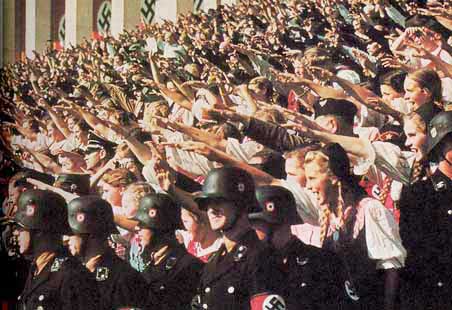
The Germans are remarkably honest in their self assessment.  A museum named “A Topography of Terror” sits by a remnant of the Berlin Wall, just across the street from the former Luftwaffe ministry building of the Third Reich.  This is a massive building in which the blitz campaigns against Poland, France, and Great Britain were all planned.  The museum presents an open, factual, detailed history of the rise of the Nazi party in Germany, the atrocities it committed, and the methods it used to subvert the democracy of the Weimar Republic in 1932 and 1933.

The most important element of the success of the Nazi party was how it played on people’s needs and emotions to gain popular acceptance.  It appealed to the people’s patriotism and sense of loss over World War I.  It promoted pride in German nationalism.  When finally in power, it provided just enough economic improvement to the masses to at least keep their tacit, if not vocal, support for the regime.  In such an atmosphere many Germans who had no interest in Jews and who were not necessarily anti-Semitic, became indifferent to the fate of the Jews; as the regime gave them just enough progress and just enough pride in the nation to keep them quiet.  Even keeping all of this in mind, it is important to note that between the summer elections of 1932 and the November elections of 1932, the Nazi party lost 5% of its electoral support.

In a multi party election (November 1932) Hitler and the Nazis won 32%.  They had the largest number of seats in the Reichstag so Hitler was brought into the government as chancellor.  In early 1933 the Reichstag fire precipitated the passing of a series of emergency laws giving Hitler authoritarian power.  Common knowledge holds the fire was set by the Nazis to create grounds for demanding these powers.

New elections were called; but the Social Democrats, the largest main stream party, and the Communist Party were outlawed.  The Centrist Catholic party was disbanded after the government passed laws disallowing any political party other than the Nazi party.  Leaders of opposition parties were arrested and put into the first concentration camps.  These included a number of high profile, democratically elected officials.  Any party affiliation other than the Nazi party; or any perspective voiced other than that of the Nazis, was equated with being unpatriotic.  The museum had numerous pictures of political leaders publically shamed before being sent to prison for their opposition to the Nazis.

On April 1, 1933 was the first official act against Jews in the form of a boycott of all Jewish owned businesses.  The museum is blunt in its portrayal of the persecution of Jews throughout the Nazi period as well as persecution of Gypsies and homosexuals.  People with disabilities were rounded up and executed as being a drain on the resources of the Fatherland.

On May 10, 1933 was a book burning of all books by authors the Nazis deemed as antithetical to German and Nazi ideals.   These included the works of Heinrich Heine, the inspiration of the Social Democrats.

Through the complete manipulation of the flow of information, along with providing just enough economic improvement to lift the people’s spirits; the general populace supported the Nazi regime.  But it was a support indifferent to the details of Nazi governance.  All of the major demonstrations and speeches shown on newsreels were not spontaneous, as claimed, but staged events.  As long as that minimal level of needs was being met, and as long as the German people felt the Nazis were elevating a level of German national pride, the people ignored oppressive measures.  After all, if they were not Jews, Gypsies, homosexuals or political opponents, they believed they would be left alone.  This attitude of indifference is perhaps the scariest aspect of the success of the Nazis in Germany.

What lessons do I draw from all of this?  First, any apparent overreach by the government deserves to be questioned.  Even if it is part of protecting national security, everything deserves to be questioned in a free press.  Perhaps we will be satisfied with the answers.  Perhaps the answers lead to needed reforms.  Americans must care enough to question.  Second, no group has a monopoly on patriotism or an exclusive righteousness regarding the good of the nation.  The demonizing of each other because of a political affiliation is the first step the Nazis took.   Embracing diversity in political perspectives keeps America strong.  Third, we need to condemn and fight any singling out of specific ethnic, religious, or social groups.  This is nothing but an attempt to create straw figures for the political advantage of those seeking power.  Hate radio (the Limbaughs, Becks and their hate speech) needs to be ignored, not encouraged.  Last, we need to preserve a society completely free of censorship.  All books, whether we disagree with them or find them disgusting, should be available.  The flow of opinion and information to the public must be unimpeded.  Censorship of the written word is the enemy of a free society.

It was interesting that in the accounting of oppressive measures taken by the Nazis there was NO mention of gun control.  The passing of laws depriving Jews (and some other groups) of weapons in 1938 was a sign of the success of the oppression, not the cause of the oppression.  The Nazis succeeded because they moved quickly in 1933, when they had strong popular support, to totally subvert the democratic institutions of the Weimer Republic and to pass the initial laws against Jews.  By 1938 it was too late.  Jews were subjugated and the general German population was entranced with the seeming advances the Nazis had made.

The United States also has its “topography of terror” to confront.  The enslavement of blacks, the treatment of Native Americans, and the internment of Japanese Americans during World War II are just a few examples of sins we need to honestly assess.  But the biggest sin would be cooperation with the erosion of the freedoms of knowledge, opinion, and thought through our indifference.

            They were a prototypical upper middle class German – Jewish family.  Karl and Irmgard Romberg along with their two young boys, Manny and Ralph lived a comfortable, assimilated life in Germany.  Karl’s business prospered well after Nazi oppression had suffocated other Jewish businesses in the 1930’s, as he was the exclusive importer of English wool in western Germany.  But, as written previously, that all changed on Kristalnacht.  Their business was ruined and Karl knew it was time for the family to leave Germany.

It is clear that Karl had planned for this eventuality.  He had spirited money off to an English bank account in his trips to meet with English suppliers.  The day after Kristalnaht Manny and Ralph were each told to pick a favorite toy and then sent to the home of their uncle Emil’s widow.  Emil was Karl’s oldest brother.  He had been arrested in 1937 by the Nazis as one of the leaders of the Social Democratic party in Essen and beaten to death.  His widow (Ralph does not remember his aunt’s name) was a short, tough woman, who cared for the boys for one week.

The boys then moved back home for one day before beginning the journey to their aunt Julie in Sweden.  Julie was Karl’s older sister, who moved to Sweden years earlier with her husband, as her husband had gotten into some legal difficulties in Germany.  The boys, travelling alone, took a train to Hamburn, then a ferry to Malmo.  They went to sleep on the boat and woke up the next morning in Sweden.  Then they took a train to Stockholm where they were not met by Julie, as she had  physical difficulties, including heart problems.

The boys lived in Sweden from late November 1938 until late May 1939.  Three weeks after arriving in Sweden it snowed and they had to learn how to cross country ski in order to go to school.  One day in early May 1939 their father called and told them they were coming back to Hamburg, where their parents met them.  They had a passage booked on the Iberia to Cuba.  The boys were back in Germany for only one day, although it might have been longer as Karl did not like the accommodations.  The Iberia was not really a passenger liner, but a combination passenger and merchant ship.  The family was booked in third class which meant sleeping in hammocks.  Karl wanted to try for another ship, but Irmgard would have nothing of that and insisted on leaving Germany immediately.  In another piece of great planning by Karl, he bought a car just before leaving Germany, loaded it on the boat to Cuba, and sold it upon arrival in Cuba.  This provided enough money for the family to live on in Cuba without touching the money banked in England.

That was a fortunate bit of planning as most of the 20 thousand Jewish refugees in Cuba lived off of money provided by the JDC (Joint Distribution Committee).  These Jews were in a difficult position as they did not see Cuba as a permanent residence, but as a way station to America.  There were many reports of suicides among these Jews.  Some could not stand being dependent on JDC welfare.  Others were depressed by their inability to get a visa to enter the United States.  This was a time in which US immigration operated under a quota system, in which some countries were favored and their immigrants did not have to wait long, whereas others, such as Eastern European countries, had to wait for years to be able to enter the US.

Life for the Rombergs, however, settled into a kind of routine.  Manny and Ralph attended a Montessori school – the Miss Phillips School.  The lessons in the morning were in Spanish and in the afternoon in English.  Ralph really liked his teacher, an American, Miss Jones.  She would drive him home after school in an old Ford with a rumble seat.  They attended a Reform synagogue led by an American rabbi who spoke Spanish.  Many of the fruits and vegetables were new and strange.  They had never seen a mango, for instance.  Ralph remembers that shopping for a chicken dinner was a unique experience.  It involved watching the butcher take a live chicken and slaughter it.  One day he went with his father to buy meat at a butcher shop.  Karl spoke no Spanish, fumbled through what he wanted and paid for the meat.  As they were walking home he realized he had not gotten his change.  He went back to the butcher and tried to ask for the change and the man said in perfect Yiddish, “Bubbela, I left it for you on the counter but you walked away.”  The butcher turned out to be a Sephardic Jew.

Karl would check with the US consulate every month about a visa to the states.  Finally, they got word they could emigrate.  They had stateless papers, which the US accepted, got physicals and prepared to enter America.  Karl decided they would go in style and booked a flight on a Pan Am clipper to Miami.  From Miami they took a train to Atlanta and then another train to Chicago, where family was waiting for them.

Karl became a Fuller Brush man for two years.  One day he called on a woman who ran him through a full presentation but did not buy anything.  As he was leaving he muttered under his breath in German, “kiss my ass.”  The woman turned out to be German and when she heard him speak German asked if he was from Germany.  When he answered yes, she bought from him.

The family did very well in Chicago.  Karl eventually opened his own ladies ready to wear store.  Both boys went to college and served in the US army.  Not all of the refugees stories were tragic.  Some, like Karl and Irmgard’s family’s, ended by living and embracing all of the hope and possibilities that America represented.  They were some of the lucky few.

Karl Romberg was the youngest of the 13 Romberg children born to Julius and Fredericka.  In many ways he might have been the most successful, at least financially, of his generation of the family.  Karl was the exclusive importer of English wool for western Germany.  As a result, not only was he financially successful, but his business continued to prosper long after other Jewish businesses had collapsed because of Nazi inspired anti-Semitism.  This is because his partners/suppliers in England were not about to change importers in Germany just because of Nazi policies.  So Karl had a monopoly in English wool.

On trips to England, Karl would smuggle money out of Germany in the hollowed handle of a shaving brush.  He opened a bank account in England as a hedge against the day when he would have to get his family out of Germany.  He prospered.  The boycott against Jewish businesses in 1933 hardly affected him.  His suppliers and customers were loyal.  So he thrived when others did not.

But all of that ended at Kristalnacht.

Across the street from Karl and his family lived a non-Jewish man who had served with Karl in World War I.  He owned a set of garages and let Karl store his car there, as it was against the law in Essen in those days to park in the streets because of the regular street cleaning (part of the German phobia of orderliness).  One day, in November 1938, his war comrade came to Karl and told him to get out of town and hide for about 2 weeks.  The SS had him targeted and a large operation was being planned.  He told Karl not to ask him any questions about how he knew, or ask for any details, just to understand Karl was about to be targeted by the SS.

So Karl left town leaving his business (which was right below the family’s living quarters), his wife, his sons Manfred and Ralph, and their governess, a woman named Maria Jagode.  Maria Jagode’s story was rather interesting.  She was an orphan who was raised by nuns who ran a combination farm, school and cloister in a small town on the banks of the Rhine River.  Kristalnacht arrived.  The family, minus Karl listened from the living quarters upstairs as the Nazis took axes and sledge hammers to everything in the office below, completely destroying the business.

The main stairway to get to the living spaces upstairs ran from the garden in the back of the store.  Soon they heard the troopers stomping up the stairway.  The Nazis burst through the door with the intent of destroying the home as well.  Maria, the governess, intervened.  She spoke to the leader saying she was Catholic and that the family was leaving Germany soon and was giving all of their belongings to her.  She said she would appreciate it if the Nazis would not destroy what was going to be her furniture.  They bought this and left the apartment unharmed.

By June 1939 the family, intact, made it to Cuba, eventually moving to Chicago, where Manfred and Ralph grew up and went to college.   They learned that the World War I comrade of Karl’s who warned him was himself an SS officer who saw Karl’s name on a list to be rounded up that night.   Maria wrote to the family while they were living in Cuba.  Now comes an interesting post script to the story.

Ralph served a tour in Korea as an American GI.  He was then transferred to Germany.  One of the people he looked up was Maria Jagode, to try to aid her.  She told him that the nuns that raised her used their facilities to hide and transfer Allied pilots who were shot down during the war – a kind of underground railroad.  Ralph went to the town where the convent was to give them some help as well – but it was completely gone.  He went to question the mayor of the village who was reluctant to tell him anything.  Being an American soldier Ralph was required to always be in full uniform, so when he began to press the mayor and put on an official “air,” the mayor caved and told the tale.  The Nazis found out how the nuns were aiding Allied soldiers, locked all of them in one of the convent buildings and burned it to the ground.

The former Jewish refugee from Germany turned American officer then returned to Essen to find his old home.  It was completely bombed out except for one thing.  The stairway from the garden to the second floor was still standing – a stairway to nowhere.  A satiric monument to Maria Jagode and the nuns who raised her.