Feeds:
Posts
Comments

Archive for the ‘Uncategorized’ Category

            I noticed it first in a post by a colleague on the CCAR Facebook page – a closed community page only for Rabbis of the Reform movement.  It was a video of Sam Horowitz, a recent 13 year old bar mitzvah boy, doing a pre-choreographed dance at his lavish party at the Omni Hotel in Dallas, TX.  The dance routine began with scantily dressed girls dancing while a curtained round platform descends eventually revealing Sam.  You can see the whole routine at this link:

http://fox2now.com/2013/08/15/sam-horowitzs-amazing-bar-mitzvah-dance/

You have to admit that Sam is a very talented dancer.  The video went viral and Sam repeated the dance on GMA.  All of this provoked the usual outrage in rabbinic circles, many, many comments about the obscenity of overly lavish bar/bat mitzvah parties, questions about the values this transmits to the children, and laments over how this has become the way a sacred Jewish rite of passage is being represented in the media and the internet.  I agreed with most of the criticisms.

Then came a column by Rabbi David Wolpe, of a Beverly Hills congregation, blogging for the Washington Post.  In his vituperative column, Wolpe consistently referred to the young man sarcastically as “Sammy,” deriding him for the denigrating effect of his dance on the meaning of the bar mitzvah process.  Probably most striking was the tone of the insults he leveled at Sam writing, he “poorly approximated a pubescent Justin Timberlake.”  I do not know how many detected any irony in a Beverly Hills rabbi critiquing an over the top bar mitzvah party in Dallas, but Wolpe’s words about the young man were definitely harsh.

Even so, the reaction of most in my circles was a condemnation of the materialistic values that the dance represented and the seeming over indulgence by the parents.  Many wondered how much of a publicity hound Sam was because of his willingness to reenact the dance on TV.  No one paid much attention to the tone of Wolpe’s article until Sam’s rabbi, William Gershon, wrote a letter in response.

Rabbi Gershon did not argue with Rabbi Wolpe’s dismay over the rampant display of materialism.  He took him to task for his denigrating tone of the young man, saying such language describing one of God’s children was unbecoming of a rabbi.  He went on to give a lot of insight into Sam, his dedication to Jewish studies, his involvement in the congregation, and his love of learning the liturgy and leading the congregation in prayer.  He called Sam a “sensitive soul,” and lamented that Rabbi Wolpe had not looked beyond the surface of the dance routine to see the actual person.  To Rabbi Wolpe’s credit, he wrote a letter of apology to Sam that he posted on his blog site.  He admitted to writing the original post in anger, and that he was too quick to press the “send” button.

I do understand the angry reaction to Sam’s dance.  It does represent the worst excesses we see at so many Jewish celebrations that seem to stress the lavishness of the party instead of the holiness of the moment.  I also question why it was necessary for the Horowitz family to encourage the reenactment on Good Morning America.  The desire for publicity just feels a little wrong.  However, I do not have the mistaken belief that Sam is truly an “adult,” even though he has come to the age of responsibility in terms of Judaism.  I am very disturbed by the knee jerk reaction to Sam, as it resulted in very inappropriate words being directed at a child, and not just by Wolpe.  Too many of my colleagues jumped to conclusions.  Too many were ready to judge the young man strictly by what they saw on the video.  No one, in all the discussions I followed, asked for context (I am guilty of this too, by the way).  A lot of us got caught up in self righteousness.

It is poignant that all of this occurred during these weeks before the High Holidays, the month of Elul.  This is the time to search our souls for the repairs we need to make; to look at relationships that need to be mended.  All of this conveniently provides a lesson in the need for admission of wrong and apologies.  But I think something Rabbi Wolpe said in his apology needs a bit more examination.

He spoke about writing in anger, in reaction.  He spoke about being too quick to post his initial column on line.  Isn’t that what most of us do?  We are in a world of instant information, instant judgment, instant results, instant gratification, and instant reaction.  We are in a world in which our reaction can be instantly seen by countless numbers on the internet.  We are in a world in which our urge to click “send” too often overcomes our common sense.

What horrified me and so many colleagues was the rampant superficiality represented by the dance.  It seemed like the grossest caricature of what bar mitzvah in America has become.  To make it worse, it is just inappropriate for a 13 year old boy to be cavorting on a stage with a bunch of underdressed women.  But our reactions were superficial.  We reacted to a 3 minute U Tube video and failed to do what all of us urge others to do – look beneath the surface for the back story on Sam, to get context for this performance.  We assumed the family was Jewishly disconnected based on this video.  We assumed the worse about the boy.  We did everything we counsel our congregants not to do, beginning with pre-judgment.  We forgot there are ways to rebuke aspects of the behavior without denigrating the people or their motives.

I, for one, needed this reminder.
Read Full Post »

            I read an interesting post on the St. Petersburg blog by Karen Cyphers about “interparty” dating.  In 1960 only 5% of people were opposed to people of different political parties dating.  In 2010 that number has gone over 40% – for Republicans it is close to 50%.  Cyphers compared this to the trajectory of approval of interracial dating.  In 1958 only 4% approved of interracial dating.  In 2010 that number grew to 86%.  What is interesting about the graph published on the blog showing this data is that the growth of those against interparty dating has spiked upwards since 2008 – the year the first African American president was elected.

The statistic missing from Cyphers’ blog post was attitudes regarding interfaith dating.  My guess is that the graph for this would follow the trend for interracial dating.  From 1958 until now I believe there would be tremendous increase in the acceptance of interfaith dating.  I think this graph would be a steady increase, rather evenly through the decades as opposed to the spike in approval of interracial dating in the last 5 years.

Some might be surprised that interfaith dating was even controversial.  While it might have never been quite as controversial as interracial dating, Americans today are quick to forget the deep religious prejudices that plagued our country for much of its history.  The KKK had Catholics on its hate list right along with Jews and blacks.  Protestant prejudice against Catholicism was quite deep.  It took a special appearance by John Kennedy and a speech to the Houston Ministerial Association to allay fears enough for Kennedy, a Catholic, to carry Texas in the election.  So Catholic/Protestant dating for the first half of the 20th century was almost as unthinkable as any kind of Jewish/Christian dating.  Today, I cannot imagine much opposition to interfaith dating except for Moslems.  They have not yet gained enough of America’s trust to be THAT accepted.

All of this leads me to another thought.  If dating someone from another political party now creates more objections than interfaith dating, is that a sign that politics is now the new religion?  Allow me to explain.

For most of American history religious affiliation really had little to do with choice of political party.  True, Jews have voted Democratic in consistently high numbers, but that is because of the political needs of the generations of Jewish immigrants in the early 20th century.  Many east European Jews were not religious at all, but were politically active in labor movements.  They naturally gravitated to similar political affiliation in America.  However, it was hard to argue that one should be Democrat based on the Torah.  Further, Jews were and still are a tiny minority of the American religious population.  The greater Christian population was well represented in both political parties.  Although the Catholic vote was once mostly Democratic, that eroded much faster than the Jewish vote, which is still overwhelmingly Democratic.  Those who today identify Evangelicals as Republicans, forget that Democrat Jimmy Carter was really the first Evangelical to inject his faith into the political arena by speaking about how his faith led him to certain political positions.

Now, I venture to say, that a person’s political beliefs influence their choice of faith far more than their faith influences politics.  Unlike the past, if you know someone’s political party, you can probably predict their religion.  It was during the years of George W. Bush’s presidency that the concept of a politician being chosen or approved of by God really got traction in the political arena.  More and more church leaders who leaned Republican began to tell their congregations that if they were truly believers in God/Christ – whatever, they would vote Republican.  In other words the test of their faith was based on a political choice.

What about the Jewish world?  Well, I am sad to say that most non-Orthodox Jews use their politics to define their religion.  I have to constantly remind congregants that agreeing with the platform of the Democratic Party does not necessarily make one a good Jew.  A Baptist minister friend of mine joked that mixing religion and politics is like mixing ice cream with manure.  The ice cream will not improve the manure and the manure will surely spoil the ice cream.  I will leave you to decide what in this analogy is the ice cream and what is the manure.

We seem unable to understand is that religion and politics, if operating properly, are operating in separate arenas.  Religion is supposed to connect one with what is divine in our world.  It is supposed to make us God oriented and God sensitive.  Along the way it points to moral and ethical problems along with our need to live morally.  Our faith sensitizes us to need.  Our choice of politics only represents the policy choice we make to address that need.  There is no political mandate in religion.  Allow me to give an example.

In this week’s Torah portion we are given some instructions as to how to alleviate suffering.  Deuteronomy 24:17 – 22 teaches not to subvert the rights of strangers and the fatherless; to leave some of the gleanings in the fields for the destitute along with fruit from trees and vines.  Since very few of us own fields, orchards, or vineyards how should we carry out these commandments which, in summary, tell us to do our part to relieve the suffering of the poor?  Politicians will give various ways to solve this.  Democrats will urge social programs.  Republicans will insist on a combination of the free market providing work opportunities along with individual charity.  Religion, including Judaism, does not mandate the details of solutions.  It only commands that we care enough about the poor to find a solution.

So I conclude that our political affiliations are now the most defining  boundaries in our country.  Few people really care about what church or synagogue you attend.  In fact affiliation rates are dropping fast for all religious denominations.  No, identities are more defined by the church of Democrat and the church of Republican.  And don’t you dare bring home someone from the other side to mom and dad.

Read Full Post »

            The pain is palpable.  Feelings are raw and exposed.  Here in Florida the aftermath of the trial of George Zimmerman has brought no resolutions, only a hardening of the two narratives formed around the case.  The narratives are parallel and in some ways mutually exclusive. You either see the racial tensions revolving around Martin’s death and Zimmerman’s acquittal, or you ignore them.  It either raises the specter of racial profiling, or it doesn’t, depending on which narrative of the story you accept.

One narrative goes something like this.  Zimmerman was a concerned citizen living in a neighborhood experiencing a run of thefts.  He saw a suspicious, unknown person walking in the neighborhood.  This suspicious person had followed a car into the gated neighborhood through the car gate as opposed to the pedestrian entrance.  Zimmerman followed him for a bit, and called the police.  The police told him they were sending someone and he did not have to follow that person any more.  That person, Trayvon Martin, turned out to be a juvenile delinquent with a growing record, who had been suspended from his school in Miami for possessing drugs.  Martin, on the phone with his girlfriend when he realized someone was following him, referred to Zimmerman as a “creepy cracker.”  Being prone to violence; rather than going into his father’s girlfriend’s home, which he was visiting, turned and violently attacked Zimmerman.  He pushed him to the ground and pummeled him, until Zimmerman, fearing for his life, pulled his gun and shot Martin.

This narrative also interprets the aftermath of the events as follows.  While not a racially motivated killing, the media sensationalized it into one.  First NBC doctored the recording of Zimmerman’s 911 call to create the impression that he was racist.  Second, the media brought in a constant discussion of the “Stand Your Ground” law, even though the defense never used it as a basis for their defense of Zimmerman.  Race baiters around the country turned Martin from a nascent criminal into an innocent angel.  This narrative places the blame squarely on Martin, and while not saying he deserved to die, sees his series of actions as suspicious, violent, and the real reason he was killed.  Zimmerman is just an innocent citizen, doing his civic duty to the neighborhood.

Now for the second narrative:  Zimmerman was a police wannabe.  Having been rejected from a law enforcement program, he went on to start a Neighborhood Watch in his community.  He had a habit of calling the police, making dozes of calls in the few years before the run in with Trayvon Martin.  That night, he saw a young black male wearing a hoodie.  His 911 call to the police demonstrated his disdain through his comment, “These (expletive) they always get away.”  His trailing of Martin, a troubled young person from a split family, scared Martin, who expressed his fear to his girlfriend on the phone.  Martin had been doing nothing but walking back to the house he was staying in after buying some Skittles and an ice tea at a convenience store.  Zimmerman’s suspicions were based on the fact Martin was black and wearing a hoodie – that is he profiled him based on race and dress.  Martin panicked and attacked Zimmerman because Zimmerman was following him.  This narrative sees racism in attempts to turn the deceased from a victim into the perpetrator.

I have now spent time with the Dream Defenders – the group of young people, primarily but not exclusively, people of color; who are staging a non-violent protest in the governor’s office at the Florida state capital.  I have listened to their fears, concerns and most important – their stories.  Their protest is not really about Trayvon Martin, but a larger context.  They see the constant singling out of black males placed under suspect, and all fear either for themselves or friends and relatives.  They do not wish to walk the streets in fear for their lives.  They want to see the stream of young black males that leads right from the schools to the prisons be addressed.  They see a context that includes the racism demonstrated after Marc Anthony sang “God Bless America” at the All-Star game in July (check out the tweets calling Anthony who is a first generation American of Puerto Rican parents, a Mexican, non American, a travesty – those were the nicer comments).  They see the failure of Republicans in the House of Representatives to take fair immigration reform seriously.  They see a Fox interview with Reza Aslan in which his qualifications to write a book about Jesus are questioned solely because he is Moslem.  They see a swath of America that refuses to acknowledge the open prejudice that is exhibited every day.  They see a part of America that denigrates the poor as unworthy instead of unfortunate.  They are trying to work within the democratic process to begin the process of change here in Florida.  They are searching for justice, a justice with some heart.

This week’s parashah is Shoftim, which means “judges.”  We are instructed to create a system of courts that treats everyone with equal respect and consideration.  No deference is to be shown to either the wealthy and powerful, or the weak and poor.  It contains one of the most famous lines in the Torah, tzedek, tzedek tirdof, which we generally translate as “Justice, justice shall you pursue.” (Deuteronomy 16:20) One of the most important aspects of God’s instructions is that they charge us with the responsibility to do this.  Human action is required to construct the justice system.  Once that system is up and operating; it is fair to ask if it is commensurate with the legal and moral expectations that God requires of us.

That is what the Dream Defenders are doing.  They are questioning both the technical details of the law (e.g. is “Stand Your Ground” necessary) as well as the morality behind a circumstance that leads to the death of a young black male who was headed back to the house he was visiting after buying Skittles and ice tea.  One can accept the idea that a “not guilty” verdict for Zimmerman was the only possible one the jury could render under Florida law.  But “not guilty” does not mean innocent.  Zimmerman’s suspicions of a young man dressed in a hoodie who turned out to be black, his initial pursuit, and the attitude he must have projected that evening all contributed to the tragedy.  On the other hand, Martin went in the wrong gate and decided not to just hurry home after seeing he was being followed.  We will never really know if in the 3 minute gap between the end of Zimmerman’s 911 call, and the first of the neighbor’s 911 calls, if Zimmerman decided to continue pursuit or Martin doubled back to assault him.  What we can say with certainty is that Trayvon Martin was a troubled, struggling teenager – a kid – who made some dumb decisions.  He should not have had to die for them.

Finally, the word tzedek not only means “justice,” but “righteous” as well (see the use in Isaiah 11:4).  We can read Deuteronomy 16:20 not only as “justice, justice shall you pursue,” but “righteousness, righteousness you shall pursue” as well.  The Dream Defenders are merely asking where is the righteousness within this justice?  I wish I had the answer.

Read Full Post »

            I got home Monday evening from 2 months of amazing journeys – a lot of which have occupied this blog space for the past 2 plus months.  But upon arriving home it was time to catch up on the few TV shows I like to follow.  One of them is “Real Time with Bill Maher.”  I know.  Bill Maher is a kind of love him or hate him guy.  I think he is really funny, often clever, but I do admit there are some moments; some comments that make me cringe.  Last night I watched the episode that first aired last Friday evening.  Among his guests was the Reverend Jim Wallis.

Wallis is an evangelical pastor, but one who embraces many causes for social justice often not associated with evangelical Christians.  His presence shows how misunderstood the depth and breadth of the evangelical Christian movement really is.  It is far more diverse, far more embracing of a multitude of political views and agendas than most people think.  This is a lesson I have learned in my years in Tallahassee.  Evangelicals come in many different stripes and beliefs, but united by the desire to spread the “good news” of Jesus’ message.  Maher calls Wallis “one of the good ones.”

One aspect of their conversation was really interesting.  After Wallis told how Jesus’ message about the poor (he cited Matthew 25 about how you treat the least is how you are treating Me) has shaped his perspective on social issues.  Maher began to push him about accepting the Bible as being from a perfect God.  Maher’s critique (and the critique of all atheists) is that it contains not just the messages about peace and love, but a lot of laws that seem arcane and cruel as well as passages justifying the slaughter of innocent populations in God’s name.  Wallis tried to respond that the overall message was one of love, of caring for the stranger, but Maher would have none of that, saying that he did not see how one could get guidance from a book containing so many hateful passages along side of the inspiring ones.   Maher’s underlying question was really how can this book, filled with these contradictions, be considered a guide for anyone.

I would like to provide the answer that Rev. Wallis could not.  He could not give this answer and still be considered an evangelical Christian pastor.  Mordecai Kaplan, the rabbi who founded the Reconstructionist movement taught the following.  The Bible (in particular the Hebrew Bible) was not written by God and handed to humans.  Rather it is the human record of interaction with God.  I believe that the preponderance of evidence, including Biblical literary criticism, source criticism and just plain logic confirm that the Bible is a human construct that wrestles with the nature of God.  The power of the Hebrew Bible, and I daresay the Christian Bible as well, is that reflects the range of human emotions, actions, and beliefs about God.  It contains the good, the bad, and the ugly.  I contend that is a great thing, not a flaw.

Moreover, the figures of the Hebrew Bible are not superheroes, not demi-god figures portrayed as perfect.  They are humans with all human flaws.  Moses, David, Solomon, all of the prophets – they are presented with all their great achievements as well as all of their warts.  Of what use would a Bible be that only presented the good side of human existence and reality?  If we did not see the misapplication of religion in the Bible how could we then really understand the heights to which profound, moral spirituality can lift a person?  Most important, the Bible, particularly the Torah, actually commands us to use our intellectual and spiritual faculties to make choices about the kind of life we wish to live.

A great example of this is in this week’s parashah (Torah portion), Re’eh.  The first word, re’eh, is the imperative form of the verb “to see.”  We are commanded to “see” something.  The Torah says, “Anochi notein lifneichem b’rachah u’klalah.” “I put before you blessing and curse.”  The command to see this is a command to understand and perceive it.  We can often “look” at something but not “see” it.  Seeing means a level of comprehension beyond what is obvious on the surface.  Jews are not literalists who are ever satisfied with the plain sense of the words.  We are trained to question, to investigate – to seek out – the meanings within the text.  Meaningful choices can only be made after “seeing.”

Unfortunately, most people only “look.”  Most people either accept or condemn based on a cursory reading or understanding of Torah/Bible.  Seeing takes effort; an effort most are not willing to make.  Yet that effort can lead to life that is indeed filled with blessing, not only for the individual, but all the people that person might affect as well.  The true beauty and power of the Bible is that it takes all of the possibilities open to humanity and tries to understand those possibilities in the context of the divine.  It is a lens for forming our relationship with God.  Through proper study and reflection, it becomes a lens for living life.

Read Full Post »

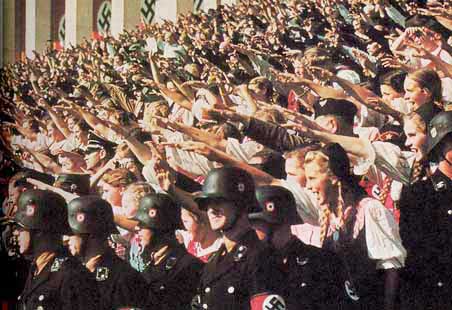
The Germans are remarkably honest in their self assessment.  A museum named “A Topography of Terror” sits by a remnant of the Berlin Wall, just across the street from the former Luftwaffe ministry building of the Third Reich.  This is a massive building in which the blitz campaigns against Poland, France, and Great Britain were all planned.  The museum presents an open, factual, detailed history of the rise of the Nazi party in Germany, the atrocities it committed, and the methods it used to subvert the democracy of the Weimar Republic in 1932 and 1933.

The most important element of the success of the Nazi party was how it played on people’s needs and emotions to gain popular acceptance.  It appealed to the people’s patriotism and sense of loss over World War I.  It promoted pride in German nationalism.  When finally in power, it provided just enough economic improvement to the masses to at least keep their tacit, if not vocal, support for the regime.  In such an atmosphere many Germans who had no interest in Jews and who were not necessarily anti-Semitic, became indifferent to the fate of the Jews; as the regime gave them just enough progress and just enough pride in the nation to keep them quiet.  Even keeping all of this in mind, it is important to note that between the summer elections of 1932 and the November elections of 1932, the Nazi party lost 5% of its electoral support.

In a multi party election (November 1932) Hitler and the Nazis won 32%.  They had the largest number of seats in the Reichstag so Hitler was brought into the government as chancellor.  In early 1933 the Reichstag fire precipitated the passing of a series of emergency laws giving Hitler authoritarian power.  Common knowledge holds the fire was set by the Nazis to create grounds for demanding these powers.

New elections were called; but the Social Democrats, the largest main stream party, and the Communist Party were outlawed.  The Centrist Catholic party was disbanded after the government passed laws disallowing any political party other than the Nazi party.  Leaders of opposition parties were arrested and put into the first concentration camps.  These included a number of high profile, democratically elected officials.  Any party affiliation other than the Nazi party; or any perspective voiced other than that of the Nazis, was equated with being unpatriotic.  The museum had numerous pictures of political leaders publically shamed before being sent to prison for their opposition to the Nazis.

On April 1, 1933 was the first official act against Jews in the form of a boycott of all Jewish owned businesses.  The museum is blunt in its portrayal of the persecution of Jews throughout the Nazi period as well as persecution of Gypsies and homosexuals.  People with disabilities were rounded up and executed as being a drain on the resources of the Fatherland.

On May 10, 1933 was a book burning of all books by authors the Nazis deemed as antithetical to German and Nazi ideals.   These included the works of Heinrich Heine, the inspiration of the Social Democrats.

Through the complete manipulation of the flow of information, along with providing just enough economic improvement to lift the people’s spirits; the general populace supported the Nazi regime.  But it was a support indifferent to the details of Nazi governance.  All of the major demonstrations and speeches shown on newsreels were not spontaneous, as claimed, but staged events.  As long as that minimal level of needs was being met, and as long as the German people felt the Nazis were elevating a level of German national pride, the people ignored oppressive measures.  After all, if they were not Jews, Gypsies, homosexuals or political opponents, they believed they would be left alone.  This attitude of indifference is perhaps the scariest aspect of the success of the Nazis in Germany.

What lessons do I draw from all of this?  First, any apparent overreach by the government deserves to be questioned.  Even if it is part of protecting national security, everything deserves to be questioned in a free press.  Perhaps we will be satisfied with the answers.  Perhaps the answers lead to needed reforms.  Americans must care enough to question.  Second, no group has a monopoly on patriotism or an exclusive righteousness regarding the good of the nation.  The demonizing of each other because of a political affiliation is the first step the Nazis took.   Embracing diversity in political perspectives keeps America strong.  Third, we need to condemn and fight any singling out of specific ethnic, religious, or social groups.  This is nothing but an attempt to create straw figures for the political advantage of those seeking power.  Hate radio (the Limbaughs, Becks and their hate speech) needs to be ignored, not encouraged.  Last, we need to preserve a society completely free of censorship.  All books, whether we disagree with them or find them disgusting, should be available.  The flow of opinion and information to the public must be unimpeded.  Censorship of the written word is the enemy of a free society.

It was interesting that in the accounting of oppressive measures taken by the Nazis there was NO mention of gun control.  The passing of laws depriving Jews (and some other groups) of weapons in 1938 was a sign of the success of the oppression, not the cause of the oppression.  The Nazis succeeded because they moved quickly in 1933, when they had strong popular support, to totally subvert the democratic institutions of the Weimer Republic and to pass the initial laws against Jews.  By 1938 it was too late.  Jews were subjugated and the general German population was entranced with the seeming advances the Nazis had made.

The United States also has its “topography of terror” to confront.  The enslavement of blacks, the treatment of Native Americans, and the internment of Japanese Americans during World War II are just a few examples of sins we need to honestly assess.  But the biggest sin would be cooperation with the erosion of the freedoms of knowledge, opinion, and thought through our indifference.

Read Full Post »

            They were a prototypical upper middle class German – Jewish family.  Karl and Irmgard Romberg along with their two young boys, Manny and Ralph lived a comfortable, assimilated life in Germany.  Karl’s business prospered well after Nazi oppression had suffocated other Jewish businesses in the 1930’s, as he was the exclusive importer of English wool in western Germany.  But, as written previously, that all changed on Kristalnacht.  Their business was ruined and Karl knew it was time for the family to leave Germany.

It is clear that Karl had planned for this eventuality.  He had spirited money off to an English bank account in his trips to meet with English suppliers.  The day after Kristalnaht Manny and Ralph were each told to pick a favorite toy and then sent to the home of their uncle Emil’s widow.  Emil was Karl’s oldest brother.  He had been arrested in 1937 by the Nazis as one of the leaders of the Social Democratic party in Essen and beaten to death.  His widow (Ralph does not remember his aunt’s name) was a short, tough woman, who cared for the boys for one week.

The boys then moved back home for one day before beginning the journey to their aunt Julie in Sweden.  Julie was Karl’s older sister, who moved to Sweden years earlier with her husband, as her husband had gotten into some legal difficulties in Germany.  The boys, travelling alone, took a train to Hamburn, then a ferry to Malmo.  They went to sleep on the boat and woke up the next morning in Sweden.  Then they took a train to Stockholm where they were not met by Julie, as she had  physical difficulties, including heart problems.

The boys lived in Sweden from late November 1938 until late May 1939.  Three weeks after arriving in Sweden it snowed and they had to learn how to cross country ski in order to go to school.  One day in early May 1939 their father called and told them they were coming back to Hamburg, where their parents met them.  They had a passage booked on the Iberia to Cuba.  The boys were back in Germany for only one day, although it might have been longer as Karl did not like the accommodations.  The Iberia was not really a passenger liner, but a combination passenger and merchant ship.  The family was booked in third class which meant sleeping in hammocks.  Karl wanted to try for another ship, but Irmgard would have nothing of that and insisted on leaving Germany immediately.  In another piece of great planning by Karl, he bought a car just before leaving Germany, loaded it on the boat to Cuba, and sold it upon arrival in Cuba.  This provided enough money for the family to live on in Cuba without touching the money banked in England.

That was a fortunate bit of planning as most of the 20 thousand Jewish refugees in Cuba lived off of money provided by the JDC (Joint Distribution Committee).  These Jews were in a difficult position as they did not see Cuba as a permanent residence, but as a way station to America.  There were many reports of suicides among these Jews.  Some could not stand being dependent on JDC welfare.  Others were depressed by their inability to get a visa to enter the United States.  This was a time in which US immigration operated under a quota system, in which some countries were favored and their immigrants did not have to wait long, whereas others, such as Eastern European countries, had to wait for years to be able to enter the US.

Life for the Rombergs, however, settled into a kind of routine.  Manny and Ralph attended a Montessori school – the Miss Phillips School.  The lessons in the morning were in Spanish and in the afternoon in English.  Ralph really liked his teacher, an American, Miss Jones.  She would drive him home after school in an old Ford with a rumble seat.  They attended a Reform synagogue led by an American rabbi who spoke Spanish.  Many of the fruits and vegetables were new and strange.  They had never seen a mango, for instance.  Ralph remembers that shopping for a chicken dinner was a unique experience.  It involved watching the butcher take a live chicken and slaughter it.  One day he went with his father to buy meat at a butcher shop.  Karl spoke no Spanish, fumbled through what he wanted and paid for the meat.  As they were walking home he realized he had not gotten his change.  He went back to the butcher and tried to ask for the change and the man said in perfect Yiddish, “Bubbela, I left it for you on the counter but you walked away.”  The butcher turned out to be a Sephardic Jew.

Karl would check with the US consulate every month about a visa to the states.  Finally, they got word they could emigrate.  They had stateless papers, which the US accepted, got physicals and prepared to enter America.  Karl decided they would go in style and booked a flight on a Pan Am clipper to Miami.  From Miami they took a train to Atlanta and then another train to Chicago, where family was waiting for them.

Karl became a Fuller Brush man for two years.  One day he called on a woman who ran him through a full presentation but did not buy anything.  As he was leaving he muttered under his breath in German, “kiss my ass.”  The woman turned out to be German and when she heard him speak German asked if he was from Germany.  When he answered yes, she bought from him.

The family did very well in Chicago.  Karl eventually opened his own ladies ready to wear store.  Both boys went to college and served in the US army.  Not all of the refugees stories were tragic.  Some, like Karl and Irmgard’s family’s, ended by living and embracing all of the hope and possibilities that America represented.  They were some of the lucky few.

Read Full Post »

Karl Romberg was the youngest of the 13 Romberg children born to Julius and Fredericka.  In many ways he might have been the most successful, at least financially, of his generation of the family.  Karl was the exclusive importer of English wool for western Germany.  As a result, not only was he financially successful, but his business continued to prosper long after other Jewish businesses had collapsed because of Nazi inspired anti-Semitism.  This is because his partners/suppliers in England were not about to change importers in Germany just because of Nazi policies.  So Karl had a monopoly in English wool.

On trips to England, Karl would smuggle money out of Germany in the hollowed handle of a shaving brush.  He opened a bank account in England as a hedge against the day when he would have to get his family out of Germany.  He prospered.  The boycott against Jewish businesses in 1933 hardly affected him.  His suppliers and customers were loyal.  So he thrived when others did not.

But all of that ended at Kristalnacht.

Across the street from Karl and his family lived a non-Jewish man who had served with Karl in World War I.  He owned a set of garages and let Karl store his car there, as it was against the law in Essen in those days to park in the streets because of the regular street cleaning (part of the German phobia of orderliness).  One day, in November 1938, his war comrade came to Karl and told him to get out of town and hide for about 2 weeks.  The SS had him targeted and a large operation was being planned.  He told Karl not to ask him any questions about how he knew, or ask for any details, just to understand Karl was about to be targeted by the SS.

So Karl left town leaving his business (which was right below the family’s living quarters), his wife, his sons Manfred and Ralph, and their governess, a woman named Maria Jagode.  Maria Jagode’s story was rather interesting.  She was an orphan who was raised by nuns who ran a combination farm, school and cloister in a small town on the banks of the Rhine River.  Kristalnacht arrived.  The family, minus Karl listened from the living quarters upstairs as the Nazis took axes and sledge hammers to everything in the office below, completely destroying the business.

The main stairway to get to the living spaces upstairs ran from the garden in the back of the store.  Soon they heard the troopers stomping up the stairway.  The Nazis burst through the door with the intent of destroying the home as well.  Maria, the governess, intervened.  She spoke to the leader saying she was Catholic and that the family was leaving Germany soon and was giving all of their belongings to her.  She said she would appreciate it if the Nazis would not destroy what was going to be her furniture.  They bought this and left the apartment unharmed.

By June 1939 the family, intact, made it to Cuba, eventually moving to Chicago, where Manfred and Ralph grew up and went to college.   They learned that the World War I comrade of Karl’s who warned him was himself an SS officer who saw Karl’s name on a list to be rounded up that night.   Maria wrote to the family while they were living in Cuba.  Now comes an interesting post script to the story.

Ralph served a tour in Korea as an American GI.  He was then transferred to Germany.  One of the people he looked up was Maria Jagode, to try to aid her.  She told him that the nuns that raised her used their facilities to hide and transfer Allied pilots who were shot down during the war – a kind of underground railroad.  Ralph went to the town where the convent was to give them some help as well – but it was completely gone.  He went to question the mayor of the village who was reluctant to tell him anything.  Being an American soldier Ralph was required to always be in full uniform, so when he began to press the mayor and put on an official “air,” the mayor caved and told the tale.  The Nazis found out how the nuns were aiding Allied soldiers, locked all of them in one of the convent buildings and burned it to the ground.

The former Jewish refugee from Germany turned American officer then returned to Essen to find his old home.  It was completely bombed out except for one thing.  The stairway from the garden to the second floor was still standing – a stairway to nowhere.  A satiric monument to Maria Jagode and the nuns who raised her.

Read Full Post »

            There is an interesting connection between my grandfather, Walter Romberg, and his younger brother Oskar.  Both originally married Jewish women.  Each fathered a son with their first wife.  Walter divorced his first wife, Martha, which is really no surprise as this was a forced marriage resulting from Martha’s pregnancy resulting in my father.  Oskar’s first wife died.  Each man then remarried in the year 1932.  The second wife of each man was Catholic, not Jewish.  Each of the women were significantly younger then their husbands – 15 and 14 years respectively.  Most strange, perhaps, is that each had the same name – Margarethe.  I cannot continue the story of the Romberg family without paying at least a small tribute to these two women.  They turned out to have much more in common than the fact they were both Catholic and had the same name.

Stop and think for a moment about the atmosphere in Germany in 1932.  While Hitler had not yet taken power, the Nazi party had grown tremendously in popularity.  A combination of the economic depression along with the humiliation most Germans felt by the victory in World War I by the allies primed the populace for the Nazi message which promised a return of German pride and power and improved economic circumstances.  Blaming the Jews for the country’s problems was not a tactic new or unique to the Nazis.  They were just more vehement and violent about it than any group previously in European history.  So even though Hitler had not yet become chancellor in 1932, that year did contain two national elections which saw huge support for the Nazis and their messages.

All of this means that even though there were no official government policies targeting Jews in 1932, hatred of Jews was certainly on the rise.  Hitler and the Nazis made no secret of their desires to carry out punishment for the Jewish “crimes” against the fatherland.  Despite this certain unfriendly atmosphere for Jews, both Margarethes fell in love with and married Jewish men.  Oskar’s in-laws were not happy that their daughter married a Jew.  They warned their daughter this would lead to trouble.  These warnings did not deter her.

Even more impressive for each of the women is how they stayed with their Jewish husbands as the laws against Jews became more and more harsh.  Both endured pressure from non-Jewish Germans to divorce their husbands.  In Essen, Oskar’s wife was called into the Gestapo headquarters a number of times and told she should no longer be married to a Jew.  Cousin Anne actually showed us the building which contained the Gestapo in Essen.  It is now just a benign office building, but Anne cannot help but think of what her mother went through each time she passes it.

In Cologne, Walter’s wife endured tremendous hardship in order to stay with him.  In the face of the pressure to leave Walter she actually tried to help Jewish families being deported by preparing food for their journeys and going to the gathering camp to bring it to them.  Both women tried to help Jewish shopkeepers clean up their destroyed stores in the aftermath of Kristalnacht.

Each of the Margarethes also walked a fine line between protecting their children but not letting them forget they were the children of Jewish heritage.  After Walter died in 1942 an allied bombing raid destroyed many of the offices containing official records in Cologne.  Walter’s widow told her girls not to mention their father was Jewish.  Now there was no way to prove anything.  Yet, later on when Charlotte got involved with an informal Hitler youth group in which the girls wanted her to be a leader, her mother told her not to forget who she was or where she came from.  In Essen, Oskar’s daughter’s, Doris and Ilse, endured comments and deliberate exclusion because their father was Jewish.  One time they told their mother that they were the only children on the block not given chocolate promised by a neighbor to all of the children.  Their mom said she knew the neighbor meant to give them some and found some bread for them as a kind of “consolation” prize.

Both women endured horrid living conditions.  Walter’s widow had to contend with constant allied bombings of Cologne, and often being excluded from the bomb shelters.  She had apartments bombed along with the loss of all their possessions as well as being evacuated to Sudetenland.  Oskar’s family had to move more than 20 times.  Often Oskar was gone (probably hidden by the priest when sought by the Gestapo).  His wife sent their daughters to south Germany to be hidden, and when they were discovered she went herself to fetch them, even though she was pregnant at the time.

Both women were the glue that held their respective families together.  This clearly had to be the case for Walter’s widow after he died in 1942, but for Oskar’s wife as well, she endured many times when he was being hidden, she had to be the one who worked to support the family and of course for a number of months she was alone with her daughters while Oskar was in Theresienstadt.

So I salute and honor both Margarethe Rombergs posthumously.  They were clearly two amazing women who helped our family navigate the hardest times and circumstances one can imagine.

Read Full Post »

            Oskar’s disappearance in November of 1944 took the family by surprise.  Perhaps they were so used to Father Vorspel successfully hiding him whenever the Gestapo sought him out.  More likely, it was simply the result of Margarethe’s having to travel to the Black Forest to bring their daughters home to Essen.  Doris and Ilse had been sent to an abbey by the priest, as he was afraid they would be taken away as Jews.  However, after a year and a half of living with the nuns, someone from Essen happened to be travelling there and recognized them.  So Margarethe went to bring them home.

But it was not an easy journey.  First of all, Margarethe was pregnant.  Secondly, Doris fell ill with appendicitis.  She was hospitalized for two weeks.  No one visited her, but one nun brought her a knitting toy.  By the time she was able to travel and Margarethe finally got her home, Oskar had disappeared and no one had any clue as to how or when it happened.  One day a neighbor had seen him.  The next he was gone.

Margarethe would visit whatever remnant of the Jewish community was left to see if any word had come of Oskar’s whereabouts.  Finally they received a post card from him in Holzmindin, a transfer camp.  Doris wrote her father a letter but heard nothing back.  Once again his location became a mystery.

In the early morning of March 13, 1945, Essen suffered a heavy bombing by the Allies.  The house that Margarethe and the girls lived in was destroyed.  They had made it to the bomb shelter underneath the house but lay trapped there, under the rubble until 3 in the afternoon.  Now, with no place of their own and their possessions destroyed, they were fortunate that a theology student by the name of Theo Borges had room for them in his apartment.  But still, there was no word of Oskar.

By the end of March, 1945 the Americans arrived in Essen.  Margarethe had saved one of the yellow Jewish stars that Oskar had worn.  She showed it to the Americans who then took pity on them and treated them with great kindness, spoiling the girls with chocolates and treats.  But still no word of Oskar, even though the Jewish community was able to begin to function once again and Margarethe checked with them constantly.

Finally, after yet one more visit to the Jewish authorities, a neighbor hailed Margarethe as she was returning, saying, “Mrs. Romberg, something always happens while you are away.”  At their door was a piece of cloth, a rag really, with Oskar’s handwriting.  The note simply said, “my dear wife and dear children, I will soon be with you but I am still very weak.  My friend and I went on foot, but it takes more than two weeks until I will be home again.  I am yearning for my family.  I send you many kisses.”

Oskar had been taken to Theresienstadt.  The Russians liberated the camp just two days before he was scheduled to be gassed.  Oskar was free to go but needed to recover some strength, as he weighed only 85 pounds.  Oskar was given food rations and cigarettes.  After a few weeks he began the journey back to Essen partly on foot and partly by hitchhiking on trucks.  Oskar missed his wife tremendously and did not want to return to her empty handed.  He hoarded his cigarettes and then traded them for a cut glass set of a creamer, small bowl and tray to give Margarethe.  Doris has the set in her cupboard even today.

Oskar spoke very little about Theresienstadt.  He only would say that they always needed to treat people well, with respect.  The only stories he told were ones with a touch of humor.  For example, one day a group of prisoners had to paint a barracks.  They found some potatoes and hid them in the paints so the guards would not confiscate them.  Later, they cleaned them off and made a small fire to fry them.

When Doris got married and had her first child, Andrea, Oskar would only say how lucky the child was to be able to live in a safe time in which she would never see the experiences that Oskar had seen.  His grandson would not have to live on the edge.

Read Full Post »

            Oskar Romberg was the second youngest of the 13 children of Julius and Fredericka Romberg.  He was, by his own admission, a bit of a wild child.  But the traits that his 3 remaining daughters remember most about him was his kindness, and the easy way he befriended people of all kinds.  Julius died before Oskar was ten and not too long afterwards his mother suffered a stroke that meant she could no longer care for her children – those left at home had to care for her.  Oskar provided a lot of this care.

His first marriage was to a Jewish woman, Doris Williner.  With her he had a son, Julius, but while she was pregnant with their second child had a tooth  pulled, which resolved in an infection.  The infection was never properly treated and killed her in childbirth.  She bore a child Oskar named Ilse, who died 4 weeks later – as baby had contracted the untreated infection from her mother.

A few years later Oskar met another woman, Margarethe.  She worked as a cashier in her parent’s butcher shop, which was also a kind of deli as there were tables where customers could sit and eat lunches they bought there.  Margarethe’s family was Catholic, but this presented no problems for Oskar he already had many non-Jewish friends.  By this time Oskar had established himself as a travelling salesman for furniture.  Most of his customers were not Jewish yet he had many strong relationships.  He married Margarethe in 1932.  They had two daughters; Doris, who he named in honor of his deceased first wife, and then Ilse, which was the name of his baby girl who died.  He kept a close contact with his first wife’s parents and his young girls came to look at them as relatives of their own.

This should have been an idyllic life for Oskar.  He was a successful salesman, with a wonderful new wife and two young children.  He had many friends of all sorts and even kept a close contact with his first in-laws.  But it all fell apart in just a few short years.

By1936 he was forced to quit his profession and do street labor with heavy equipment.  More and more apartment buildings did not want to rent to Jewish families.  His wife, Margarethe, was regularly called to the local Gestapo headquarters and badgered to divorce her Jewish husband.  Over he next few years the family had to move over 20 times, each time into worse conditions.

During the events of Kristalnacht, November 9 and 10, 1938, Oskar disappeared and his children did not know where he was.  Doris believes now that he was most likely hidden by a priest, Father Vorspel.  Just a short time earlier, as Oskar was no longer able to find employment that would support the family, Father Vorspel hired Margarethe to work in the priest’s quarters for the parish.  She cleaned, carried buckets of water, anything to support the family.

By the outbreak of the war in 1939, the Gestapo was actively trying to round up Jews.  One time a Nazi sympathizing neighbor saw Oskar on the street and called to the policeman on the beat that there was a Jew walking around and he better take him in.  The policeman had no desire to arrest Oskar, but did so and once he got to police headquarters, set him free.  By 1940 the family was hearing of Jews being deported.  In fact, the Williners, Oskar’s first in-laws, were deported.  Father Vorspel often hid Oskar when the Gestapo came around.  He would put him in the priest’s quarters or hide him in the recesses of the church library.

But that was not the end of the priest’s caring.  By 1943 he told the family that the young girls, Doris and Ilse, needed to be hidden, and he had the right place for them in a nunnery in south Germany.  Margarethe responded that they did not have the money for either the trip or the costs of boarding them.  Father Vorspel’s response was to not worry about the expense.  He took care of everything.  The girls were told not to tell anyone about their Jewish father and they lived with the nuns from March 1943 until November 0f 1944.  They would have stayed longer but someone from Essen came through and recognized them.  So their mother came to pick them up.  On the way home, Doris got sick with appendicitis and that delayed their trip home by two weeks – the time of the hospital stay.

Upon arriving home, Oskar was gone.  No one had seen who had taken Oskar.  Finally they got a postcard from him, sent from Holzmindin, an interim transfer camp.  After that they heard nothing.  Every few weeks Margarethe went to what remnant was left of the Jewish community to see if they had any word, but there was none.  At the end of March 1945 the Americans arrived in Essen.  The entire atmosphere of the city changed, as the Americans were extremely sympathetic.   But still there was no word about Oskar until they arrived home after yet one more trip to the Jewish community.  Someone had left a note at their apartment, written on a rag.  It read, “my dear wife and dear children, I will soon be with you but I am still very weak.  My friend and me went on foot, but it takes more than two weeks until I will be home again.  I am yearning for my family.  I send you many kisses.”

Oskar had been sent to Theresienstadt.  He was liberated by the Russians on May 1, 1945, just two days before he was scheduled to be gassed.  He was only 75 pounds the day he was liberated.

Oskar lived to have two more daughters, Anne and Beatte.  He rebuilt his furniture business, with many of his old customers giving placing large orders with him.  It was a time everything was being rebuilt and everyone needed furniture.  But Oskar’s customers made sure Oskar Romberg did very well.  They had always liked him and wanted him to prosper once again.

In Doris’s photo album of the family in the war years is a picture of the priest, Father Vorspel.  Without him, Oskar might well have been caught by the Gestapo years earlier and would not have survived.  If Father Vorspel has not been honored as one of the righteous gentiles, it needs to be rectified.  This righteous man was a priest who got it right.

Read Full Post »

« Newer Posts - Older Posts »